
80th Independence Day: Looking Back at the Tragedy CHT Encountered 79 Years Back

Chittagong Hill Tract (CHT) – today, has lost its original demography and settlers from the plains – under the Bangladesh state-driven initiatives have already damaged the original ethno-religious population structure, beyond repair. The Bangladesh state continues to corner and deny special rights to the indigenous communities of CHT, instead subjecting them to stringent scrutiny and checks in the hills, in the name of national security, to mitigate any future demands for increased autonomy by the tribes living there.
In this article, an attempt has been made to document all relevant discussions, actions, ignorance of people’s consensus and flawed decisions that sealed the fate of the people of CHT during the partition of 1947.
In July 1945, Sneha Kumar Chakma, who was from Parbattya Chattagram Jana Samiti (PCJS), went as the representative from CHT to meet Lord Wavell at the Shimla Conference, which was organised to decide on the constitutional future of India. During this conference, Sneha met with the high command of Congress, including Jawaharlal Nehru, and spoke about the willingness of the people of CHT to join India and the special provisions that they were seeking for their tribal population. Following this momentum, a memorandum was submitted to the British authorities on 15 February 1947 by Sneha Kumar Chakma (General Secretary) and Kamini Mohan Dewan (President) of the then PCJS. In that memorandum, they argued at length about the different ethno-religious identity of CHT, its linguistic and cultural differences with the rest of Bengal, with special reference to the contrast between their identity and that of the Pakistani state in formation. This desperate attempt was shaped by the fear that the CHT might also be transferred to East Pakistan, along with the Chottogram plains, as they both formed part of the same district then.
On 20 March 1947, Sneha Kumar Chakma was formally co-opted onto the Excluded and Partially Excluded Areas (Other than Assam) Sub-Committee of the Constituent Assembly of India. Accordingly, he arranged a meeting with the leaders of CHT in April 1947 to discuss the future trajectory of CHT under the Indian administration.
On 7 April 1947, Sree Satyapriya Banerjee asked the Leader of the House of the Central Legislative Assembly about the CHT’s future. He asked whether the Government knew that there was a strong feeling among the tribal population that they were not being allowed free expression concerning their future constitutional position, to which Nehru replied, “Government are unable to say whether there is such a strong feeling or not but they are aware that such views have been expressed.”
By May 1947, the situation turned more volatile as the fate of CHT was still undecided and a possible inclusion in East Pakistan was a visible possibility. PCJS formed an Action Committee to actively advocate their inclusion in India and to raise a resistance, if necessary. When the Boundary Commission was declared in June 1947, Sneha again went to meet Nehru, and he described that Nehru assured him that CHT would remain out of the Bengal Boundary Commission’s jurisdiction and that CHT would be treated as an entity of North-East India. Following Sneha’s pursuance, Nehru wrote a letter to Lord Mountbatten on 19 July 1947, stating the unique ethno-religious identity of CHT, which was not identical to that of Bengal or Pakistan and hence should be made part of India, as they were more closely connected with the tribal belts of Tripura and Assam. Nehru also underlined the desperate willingness of the representatives and people of CHT to join India and mentioned that he had assured the representatives of CHT of their inclusion into the territory of India. Highlighting the same reasons, Sneha Kumar Chakma again wrote another memorandum to the Bengal Boundary Commission on 14 July 1947.
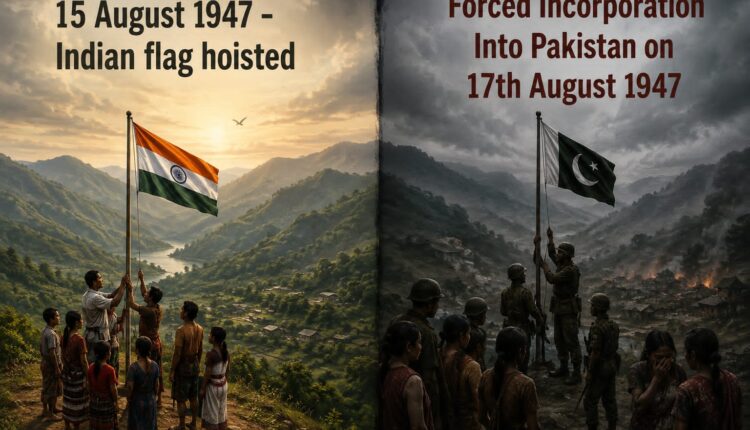
Sneha also reportedly met with Sardar Patel and asked for his help in resisting the Pakistani forces, if CHT were not to be included in India and handed over to Pakistan. Sardar Patel assured him of his support, which is reflected in the later writings of Sneha. On the night of 14th and 15th August, Sneha went to meet the DC of Rangamati to enquire whether CHT belonged to India or not. The DC, Colonel G. L. Hyde, assured Sneha and his colleagues of CHT’s inclusion in India and asked them to come at sunrise for hoisting the flag. The Indian Flag was thus raised in Rangamati on the morning of 15 August 1947. The entire CHT remained under the belief that CHT was now to remain a part of independent India.
On 16 August 1947, the Boundary Commission presented its demarcation of borders for Partitioned India before the Congress and Muslim League leadership in the Government House, New Delhi. This was a day before the public announcement of the awarding of the territories was to be made. Nehru and the Congress leadership were shocked to find out that CHT was awarded to East Pakistan. Reacting to that, Muslim League leader Fazlur Rahman vehemently supported the Commission’s plan and backed the argument of ‘contiguity’ and rather also demanded for Jalpaiguri and Darjeeling to be awarded to Pakistan under the same argument. On Mountbatten’s request – to take into account the overwhelming demand of the people of CHT to join India – Liaquat Ali Khan, the first Prime Minister of Pakistan, took a more tactical stand and offered to award CHT to India if Pakistan were to be awarded the territories of Jalpaiguri and Darjeeling. Nehru rejected that offer and retained Darjeeling.
Thus, the fate of CHT could not be altered and the same Commission plan was made public on 17 August 1947. The people and leaders of CHT were devastated and felt deprived of their just demands. The Pakistani Army entered CHT and forced its way into Rangamati. The Indian Flag was brought down and the Pakistani Flag was raised on 21 August 1947 in CHT. The Action Committee of PCJS dared to begin a resistance movement but received no help from the newly constituted Indian government. Nehru refused to get dragged into a conflict in the far east, immediately after independence. Tribal leaders of India like Jaipal Singh made strong demands in the Constituent Assembly to reclaim CHT, even months after independence, but no practical implications of such demands were ever observed. For years then, Sneha continued appealing to the Indian state and the UN but could not find any remedy for the CHT people. By 1948, refugees from CHT began pouring into India and Burma, and thus CHT had to accustom itself to the new reality, which continues to bleed its cultural and community identity and autonomy till today.
Comments are closed.