
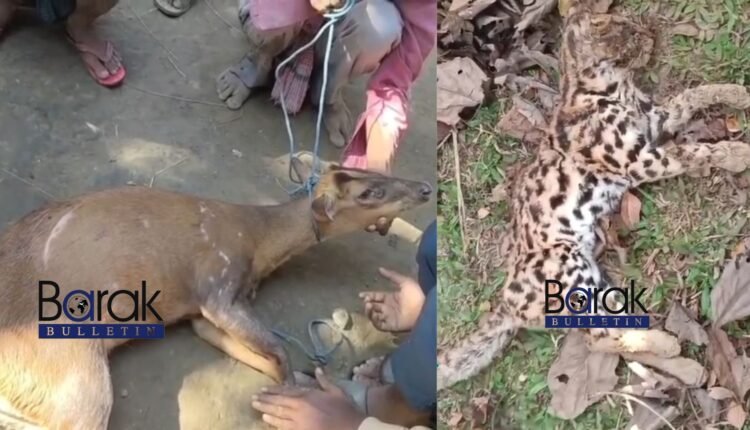
Leopard Cat Death, Injured Barking Deer Near Bhuban Hills Raise Habitat Loss Concerns; DFO Rules Out Immediate Threat

Two recent incidents involving injured wildlife near the foothills of Bhuban Hills—including the death of a leopard cat and the rescue of a pregnant barking deer—have reignited concerns over habitat loss and human encroachment in forest fringe areas. Seeking clarity, Barak Bulletin spoke to Cachar District Forest Officer Dr Palve Vijay Trimbak, who said there is “no risk of immediate habitat loss” and ruled out rampant deforestation within reserve forests.
A pregnant Indian barking deer (muntjac) was rescued on Friday morning (January 2, 2026) from the Kalakhal Forest Reserve inside the protected Bhuban Hills. Labourers working in the reserve reportedly found the animal injured and alerted the Maniarkhal Forest Beat Office. Forest personnel subsequently took the deer into custody.
Explaining the handling, Dr Trimbak said the animal was restrained briefly to prevent stress-induced complications. “We shall release the deer after treating it. As she is pregnant and wounded, we are administering proper care before relocating and releasing it in a forest away from human disturbance so that it can be safe,” he said. He added that muntjacs can suffer fatal stress if their heart rate spikes amid crowds, hence controlled restraint during treatment. The deer is an adult female and will be released after recovery.
In a separate incident, images of a tiger-like animal found dead at the foothills of Bhuban Hill went viral on Thursday (January 1, 2026), triggering panic over the possible presence of a tiger or leopard. After examination, the Forest Department identified the animal as a leopard cat, a protected species under Indian law.
Locals and wildlife enthusiasts alleged lapses, claiming the carcass was buried without a post-mortem and that the response was delayed. They also raised concerns about forest degradation. Addressing these claims, Dr Trimbak said, “Contrary to the panic situation created… it is a leopard cat, and it has died due to natural causes.”
Globally, the leopard cat is listed as “Least Concern” on the IUCN Red List, though it faces threats such as habitat loss, hunting and the pet trade in parts of its range. Trade is regulated under CITES. In India, the species receives the highest level of legal protection.
The Indian barking deer is also globally listed as “Least Concern,” but local populations face risks from poaching and habitat pressures; it is protected under Indian wildlife law.
Responding to questions on deforestation, Dr Trimbak said some forested tracts fall outside cadastral boundaries and, therefore, beyond the department’s direct jurisdiction. “When we receive complaints, we conduct surveys. There is no rampant deforestation. We are regularly patrolling reserve forests,” he said, acknowledging small-scale cultivation by forest dwellers and adding that eviction measures have been requested where necessary.
While the twin incidents have heightened scrutiny of human–wildlife interfaces around Bhuban Hills, the Forest Department maintains that reserve forests remain under regular patrol and that the injured deer will be safely rehabilitated and released.
Comments are closed.