
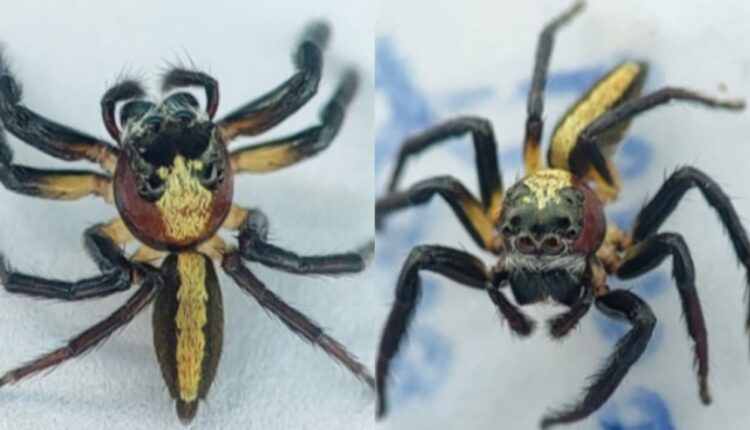

Cachar reached a new height in academics as the Department of Ecology and Environmental Science, Assam University, discovered a new rare species of spider within Cachar’s Inner Line Reserved Forest. The discovery was made by researcher Monica Chetry and her supervisor Parthankar Choudhury, former Dean of the E.P. Odum School of Environmental Sciences at Assam University, Silchar, in collaboration with noted arachnologist John T. D. Caleb of Saveetha University, Chennai.
The team recorded the presence of Colyttus bilineatus, a species of jumping spider, from Loharbond in the Cachar district. The spider had never before been documented in India. Until now, it was known only from parts of Southeast Asia, including Indonesia, Malaysia and Singapore. Its appearance in Assam marks a major extension of its known geographical range.
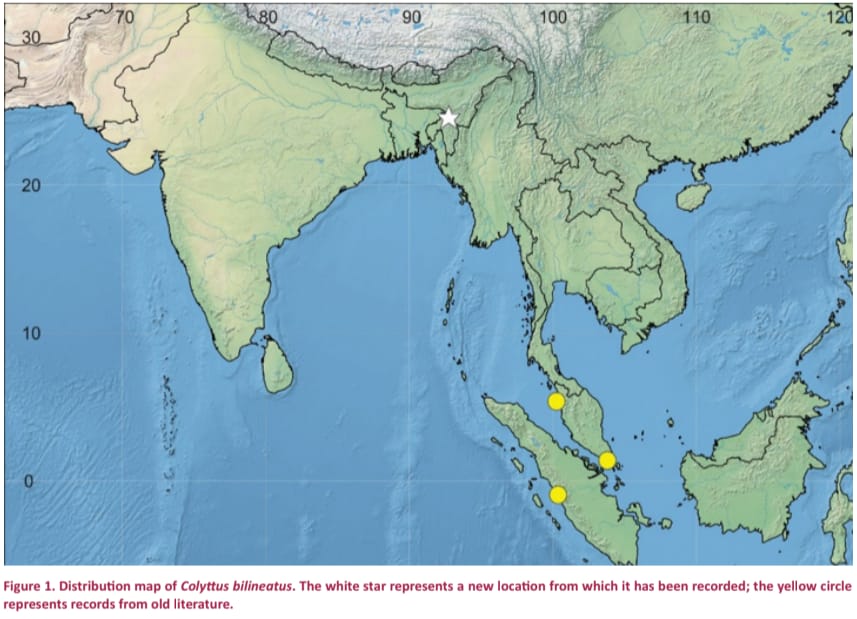 The jumping spider belongs to the genus Colyttus, which has only a few species worldwide. In India, the genus was earlier represented by just two species, Colyttus nongwar and Colyttus proszynskii. The discovery of Colyttus bilineatus adds a new member to this small Indian list and increases the known diversity of jumping spiders in the country.
Speaking to Barak Bulletin, Monica Chetry explained that the spider belongs to the class Arachnida and feeds mainly on insects. This makes it beneficial for farmers and the environment as it helps control insect populations naturally. She added that every species has its own unique traits, and this family is known for its jumping ability, which helps it catch prey. According to her, this behaviour developed through natural selection. She also said it is too early to say how the spider reached Assam, and further research is needed. It may have spread through human activity or may already exist in nearby regions, but has not yet been discovered.
Chetry also stressed the need for more research in this field. She pointed out that although there are around 53,000 species of spiders globally, studies in India remain limited. Many small species are often neglected. She said these organisms also deserve attention for better scientific understanding and a balanced academic approach. She called for improved facilities and support for researchers working in biodiversity studies.
The specimen was found on September 22, 2025, during her fieldwork on spider diversity in Cachar district, where she was studying both forest and agricultural ecosystems. She collected the spider using vegetation beating, preserved it in ethanol, and later examined it in the laboratory. Photographs were taken, and detailed morphological studies confirmed that it was a rare and previously unrecorded species in India. The specimen has now been deposited in the Wildlife Conservation Research Laboratory at Assam University.
This discovery is significant for science as it expands the known distribution of the species and highlights how much remains unexplored in the Indo-Burma biodiversity hotspot. It contributes to the understanding of Salticidae diversity and encourages further surveys of lesser-studied habitats, which may reveal more undocumented species in the future.
For Cachar, Assam University, and of course, Barak Valley, the finding is a matter of pride. Spiders are often ignored or feared in daily life, yet they play an important role in maintaining ecological balance. This discovery shows that even small and overlooked creatures can hold great academic and environmental importance, placing the region firmly on the scientific map for biodiversity research.
Comments are closed.