
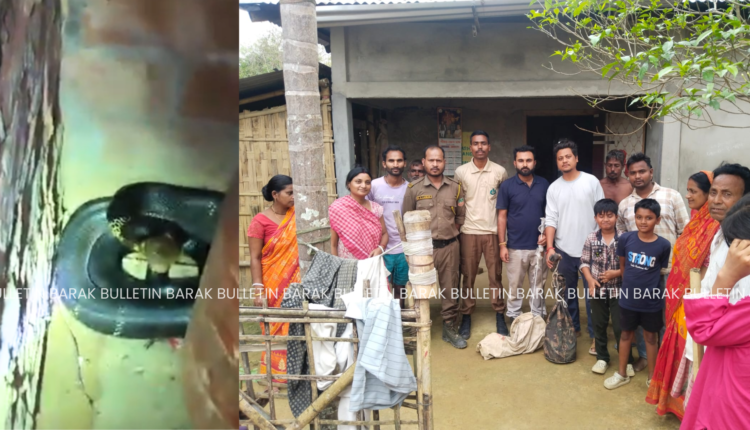
14.5-Ft King Cobra Rescued From House In Dholai, Released Safely

As the monsoon season approaches, the number of snake sightings in residential quarters increases. While this happens because of increasing habitat loss, experts also attribute this to the seasonal migration period and mating season. Frequent snake rescues have been made in the last month, especially from rural settlements of Cachar, where the reptile often enters people’s houses.
In one such operation, a massive 14.5-foot-long Northern king cobra was rescued from a residence in the Dholai area of Cachar on Tuesday afternoon (March 31), in what has been described as one of the largest snake rescues in southern Assam in recent times. The snake had entered the local’s kitchen and was slithering beside an LPG cylinder.
According to wildlife rescuer and conservationist Trikal Chakrabarty of the Barak Valley Wildlife Division, the team initially expected a routine rescue after receiving a call from the locality. However, upon reaching the spot, they were “totally shocked” by the enormous size of the reptile.
Due to the limited space inside the house and the snake’s size, the team adopted a different rescue strategy. Instead of the usual hook-and-bag method, they placed the bag inside the house near the snake. “After nearly two hours of careful operation, the Northern king cobra entered the bag on its own, and we successfully secured it without any casualties,” Chakrabarty said.
The snake was later released into its natural habitat. The rescue was carried out by Trikal Chakrabarty along with team members Sabir Ahmed, Rameshwar Chasa, and Hoodkeepers member Yogesh Thapa.
Chakrabarty stated that the 14.5-foot king cobra is the second-largest rescued in the southern Assam circle, with the largest being a 16.5-foot specimen rescued earlier from Subhang Tea Garden village in Dolu, Cachar, on April 11, 2025.
Highlighting the legal and ecological importance of the species, he noted that king cobras are protected under the Wildlife Protection Act, and killing one is a punishable offence. He also mentioned that while many locals consider the species new to the region, it has long been known in local terminology as “Raj Panok Saap” or “Raj Palak,” meaning the king of snakes.
He attributed the recent increase in king cobra sightings to seasonal migration and mating behaviour, typically observed between February and March, along with changing climatic conditions over the past few weeks.
“King cobras are highly venomous, and their neurotoxin can be extremely dangerous. If threatened, they may attack. We urge the public not to disturb them, especially when they are in their natural habitat,” he added.
Chakrabarty also advised residents to maintain cleanliness around their homes, particularly ahead of the monsoon season, as garbage accumulation can attract snakes and other animals.
The successful rescue operation once again highlights the importance of awareness and trained intervention in preventing human-wildlife conflict in the region.
Comments are closed.