
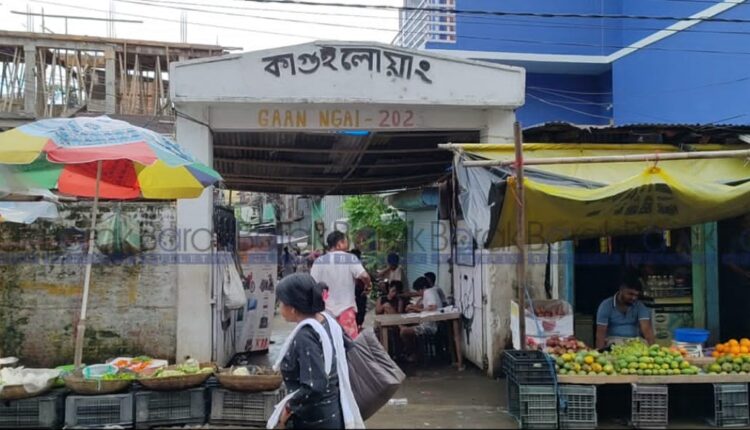
Kaguiluang: The Cultural Heart of Silchar’s Rongmei Naga Community

Byline K. Alicia Rongmei
At first glance, Kaguiluang is just another locality tucked away in the crowded neighbourhood of Fatak Bazar. But beyond its modest homes and winding lanes lies a vibrant world of memory, music, and tradition. For decades, Silchar’s Rongmei Naga community has called this place home, carrying forward its language, festivals, and customs while adapting to life in the Barak Valley without letting go of its ancestral identity.
Amid the predominantly Bengali-speaking landscape of Silchar, Kaguiluang stands out as a cultural hub of the Rongmei people. Known for their intricate handwoven shawls, harvest songs, and strong tradition of village self-rule, the Rongmei have preserved a distinct cultural identity here across generations. In the community hall, elders gather to discuss everything from land rights and festivals to wedding rituals and social affairs, ensuring that traditions continue to be passed on even as the city around them changes.
Kushing Kamei, an executive member of the Kaguiluang Development Society, said while speaking with Barak Bulletin, “Actually, we are not immigrants; we are the indigenous people of the Barak Valley.”
For generations, the Rongmei, one of the major Naga tribes also known as the Kabui, have used Silchar not just as a home but as a gateway. Historically, the plains of Cachar served as a vital link between the hills of Manipur and the rest of British India.
While the Rongmei are most prominently found in Manipur, significant Rongmei communities also live in Assam and Nagaland. In Assam’s Cachar district, localities such as Kaguiluang in Silchar have long served as important centres of Rongmei life, helping preserve the community’s culture, traditions, and connections with Rongmei populations in neighbouring states.
Every December, the community gathers to celebrate Gaan-Ngai, the most important festival of the Rongmei people, marking the end of the harvest season. Young men and women perform traditional dances and sing songs in the Rongmei language as part of the celebrations, which last for five days.
Speaking about upcoming cultural events, a local youth said, “There is an upcoming festival called Maliang, also known as Dicap, which is celebrated as a spring festival.”
The Rongmei community in Kaguiluang reflects a blend of continuity and change. While a section of the community has embraced Christianity, evident from the modest churches in the locality, many still follow traditional Rongmei beliefs centred on Tingkao Ragwang (the Heavenly God). Others display elements of both faith systems, reflecting a degree of religious syncretism. Despite these differences, Gaan-Ngai remains the community’s most important cultural festival, marking the end of the harvest season and the beginning of a new annual cycle.
To witness the Rongmei community at its vibrant best in Silchar, one must visit Kaguiluang during Gaan-Ngai. Preparations for the festival begin weeks in advance. Community elders consult the traditional calendar to determine suitable dates for the celebrations, which may vary from one village to another. Explaining this, Kamei said, “There may be a one- to two-day difference because every village has its own convenient days.”
The Rongmei Naga of Kaguiluang, in Silchar’s Fatak Bazar area, are living proof that identity is not a prison; it is a vessel. In the flat, humid geography of the Barak Valley, they have built a world of memory, music, and resilience, carrying forward traditions that have endured across generations.
As Silchar continues to expand and urbanise, the Rongmei stand firm. They remain custodians of a culture that refuses to fade into the background. In the quiet lanes of Kaguiluang, the echoes of the past still resonate through community gatherings, festivals, and songs. The ancestors are not forgotten. They are simply waiting for the next beat of the khuang to come alive once more.
Comments are closed.