
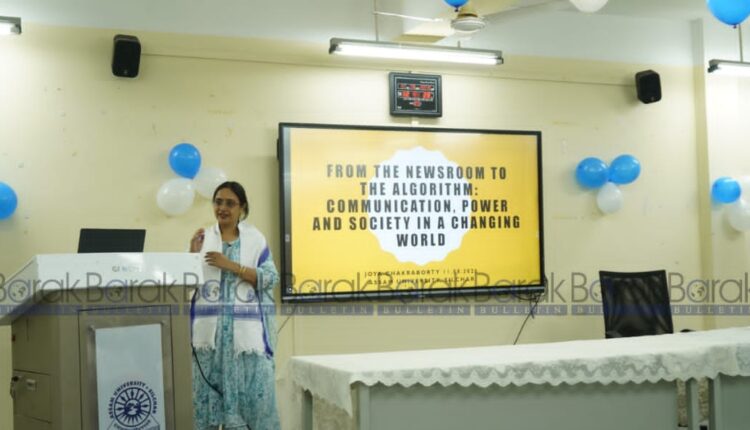
“Silence Communicates”: Prof Joya Chakraborty at Assam University Explains How Blue Ticks, Ghosting and Algorithms Are Reshaping Communication

Technology is changing not only how people consume and produce news, but also how they remember, communicate and understand silence, Prof. Joya Chakraborty said during a special lecture at Assam University, Silchar.
Prof. Chakraborty, Professor at Tezpur University and an alumna of Assam University’s Department of Mass Communication, returned to her alma mater to deliver the department’s 2nd Special Lecture as part of its 30-year anniversary celebrations on Tuesday (August 11).
Speaking on “From the newsroom to algorithm: communication, power and society in a changing world”, she examined the growing influence of algorithms, artificial intelligence, digital platforms and data-driven communication on society and journalism.
She argued that traditional communication models such as Source-Message-Channel-Receiver no longer fully explain communication in the digital age, where platforms and algorithms increasingly influence what people see, share and respond to.
‘Silence communicates’
One of the key themes of the lecture was the changing meaning of silence in digital communication.
“Silence communicates,” Prof. Chakraborty said, explaining that actions such as ghosting, muted notifications, being left on read, or the absence of a blue tick can now carry social and emotional meanings.
According to her, such digital forms of non-response have become part of everyday non-verbal communication and can influence people’s self-esteem, relationships and behaviour.
She also described another major shift in human experience by saying, “Memory has become mechanized.”
Prof. Chakraborty explained that memories and experiences that were once largely oral, private and dependent on particular social settings can now be recorded, stored and circulated as digital data.
She cautioned that this transformation also has implications for indigenous cultures. When community practices and ethnic rituals from Northeast India are recorded and uploaded on platforms such as YouTube and Instagram, they can reach audiences far removed from their original social and cultural context. This, she said, can change how such practices are understood and represented.
AI and the hidden Labour behind Technology
The professor also discussed artificial intelligence and the labour that supports modern digital platforms.
She pointed to the large number of workers in developing countries involved in low-paid and often invisible data-related work that helps process and prepare information used by AI systems.
At the same time, she noted the growing concentration of power among major technology platforms. However, she said the same platforms can also be used by grassroots groups and younger generations to build alternative narratives and challenge established centres of power.
The discussion included the use of digital platforms during movements such as the Arab Spring, where social media became an important tool for mobilisation and the circulation of alternative narratives.
For journalism students, Prof. Chakraborty stressed that technology should not replace fundamental journalistic skills.
She cautioned that automated systems cannot independently replace human contextual judgement, ethical reasoning and rigorous verification. Journalists, she said, will need to strengthen these skills as newsrooms increasingly adopt AI-driven tools.
A Homecoming after Three Decades
The lecture had particular significance for the department, which was established in 1996 and is marking 30 years of media education. The department is recognised as the first in Northeast India to offer a full-fledged postgraduate programme in Mass Communication.
The anniversary programme began with an online address by media scholar Prof. Daya Thussu last February and has continued through a year-long series of academic events.
The special lecture also brought together teachers, former students and members of the department’s early academic community.
Prof. Charvak, Head of the Department, presided over the session and presented an academic summary of Prof. Chakraborty’s lecture, highlighting her observations on changing media power, digital silence, data processing and the importance of verification in AI-assisted newsrooms.
Prof. Nirmal Kanti Roy, Dean of the Abanindra Nath Tagore School of Creative Arts and Communication Studies, felicitated Prof. Chakraborty and recalled his association with her as a contemporary and fellow student of the department.
Prof. Paromita Das delivered the vote of thanks and spoke about the personal significance of welcoming an alumna back to the department. She also acknowledged the support of Vice-Chancellor Prof. Rajive Mohan Pant and the efforts of students who decorated the seminar hall for the occasion.
Prof. Partha Sarkar, a former Head of the Department and member of its inaugural student batch, recalled the department’s early years and described Prof. Chakraborty as one of its most distinguished alumni.
The programme concluded with an interactive session in which students P. Dinamani Singha, Anamika, Roshni and Sabera raised questions concerning algorithmic bias, data ownership and ethics in AI-driven newsrooms.
For a department that has spent three decades teaching students how media shapes society, the lecture offered a timely reflection on a new question: as technology gains greater control over communication, who controls the technology that shapes what society remembers, sees and hears?
Comments are closed.