
The Mocking Doctor, the Phone and the Presiding Officer: Dear Voter PK Das

There are many things one may reasonably expect to carry into a polling station: a sense of civic responsibility, some patience, perhaps even a conviction that the candidate one is about to vote for will improve the city.
A mobile phone is a different matter.
A video from the October 3 Silchar Municipal Corporation election has travelled considerably further on social media than the legal proposition at its centre deserves.
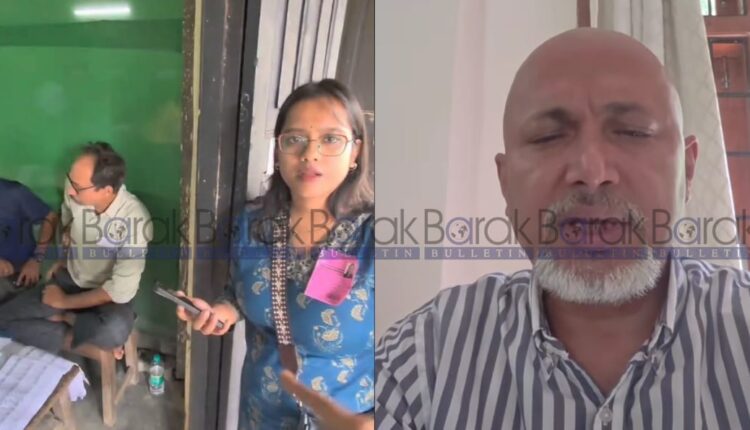
Shared by the Facebook page Smile Dental Clinic, Silchar, the video shows a man identifying himself as Dr. P.K. Das arguing with a woman probably, serving as Presiding Officer at a polling station. Dr. Das wants to use an identity document available through DigiLocker. The officer tells him that mobile phones are not permitted inside. He disagrees, points towards others with phones, films the exchange and challenges her interpretation.
He has since threatened to take the matter to court. That might actually be useful. Because a remarkably similar argument has already reached one.
In November 2024, the Bombay High Court considered a PIL asking that voters be allowed to carry mobile phones into polling stations specifically because identity documents stored on DigiLocker have legal validity. The petitioner relied on Rule 9A governing DigiLocker and argued that digitally issued documents must be treated at par with physical originals.
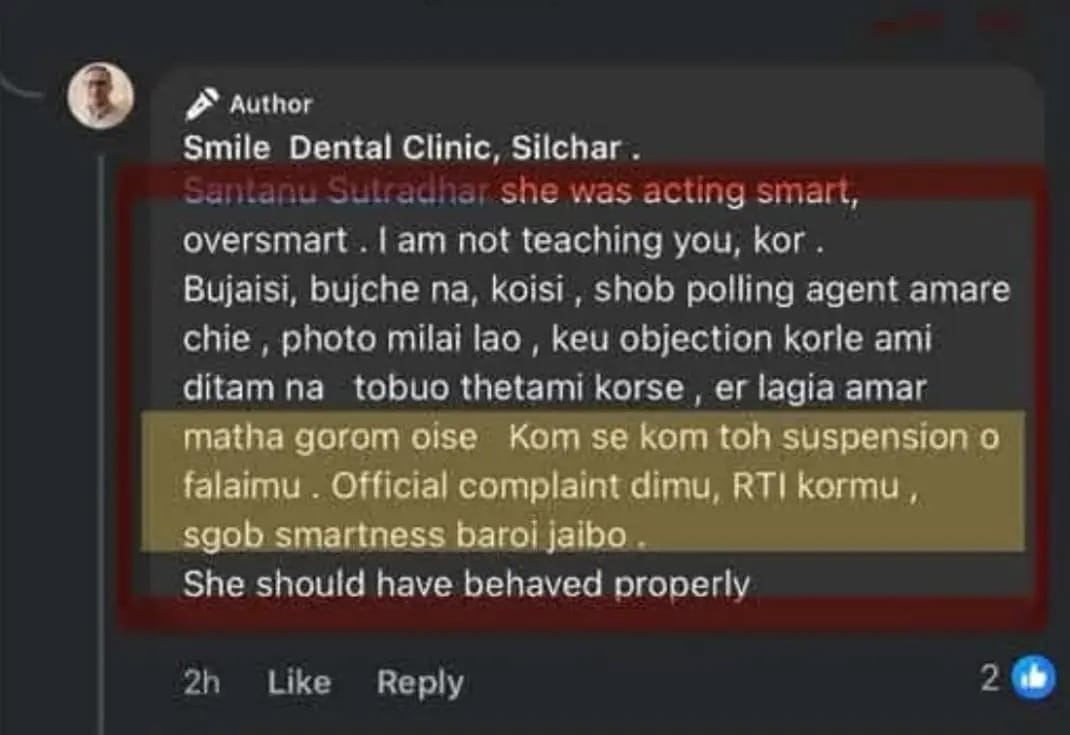
The High Court dismissed the petition. Its finding could hardly have been more relevant to the Silchar argument. Rule 9A, the court held, “does not vest any statutory right on any voter to contravene measures taken by the ECI.”
The court found “no irregularity or illegality” in the Election Commission’s restriction on mobile phones within the prescribed polling-centre area.
That is the distinction Dr. Das’s performance repeatedly fails to confront. The document may be valid. The device is still subject to regulation.
DigiLocker does not turn a mobile phone into a constitutional accessory. A smartphone remains a camera, recorder, communications device and broadcasting tool. In a polling environment, where secrecy and integrity matter, authorities can have perfectly legitimate reasons to restrict it.
This is not a theoretical concern invented in Silchar to inconvenience one dentist. During the Mumbai civic elections in January this year, a voter in Parel arrived intending to use an identity document stored on DigiLocker. His phone was not permitted inside. He went out, obtained a printed identity document, returned and voted.
Democracy survived. The constitutional position is equally inconvenient for the argument being made in the viral video.
In Kishansing Tomar v. Municipal Corporation of the City of Ahmedabad, the Supreme Court held that State Election Commissions, in their domain of municipal and panchayat elections, possess powers over the conduct of elections that are “no less than” those of the Election Commission of India in its domain. The Court also reiterated that “superintendence, direction and control” of elections have been understood in the broadest terms.
To be precise, the Bombay High Court judgment concerned an ECI restriction and does not magically become an Assam State Election Commission circular. That is not the point.
The point is that the very proposition Dr. Das appears to regard as self-evident, that a legally valid DigiLocker document necessarily entitles him to take the phone displaying it into a polling station, has been put before a constitutional court. And lost. There is, of course, nothing wrong with Dr. Das disagreeing.
Citizens should question rules. Elections should withstand scrutiny. There is even a sensible policy question here: if governments encourage citizens to keep official documents in DigiLocker, spend billions to promote Digital India, election authorities should consider mechanisms through which those documents can be verified without compromising restrictions on electronic devices.
That would be a worthwhile debate. What happened in the video is rather less impressive. Dr. Das repeatedly asks why others appear to have phones.Firstly, the people he was pointing to, including the officer herself, are authorised election individuals who have different guidelines. A fireman drives a car to the site of fire, a common man stops at the barricade before the danger zone. That is civic sense. For the sake of his argument, if unauthorised people were indeed carrying or using phones, question it. Demand uniform enforcement. File a complaint.
But someone else’s alleged violation does not produce a transferable entitlement. A man who sees another car jump a red light has discovered a violation, not a new interpretation of the traffic signal.
More troubling is the manner in which the Presiding Officer is treated. She explains her position. She is challenged. She is filmed. Her understanding of the rules is mocked. The exchange increasingly acquires the quality of a performance intended not merely to resolve a disagreement but to establish, before an eventual social-media audience, who in the room supposedly knows better.
Except the law does not become more persuasive because it is delivered loudly into a camera. Nor does professional status improve it. Inside a polling station, a doctor, lawyer, journalist, businessman or social-media personality enjoys no superior class of citizenship. That is one of the pleasingly egalitarian features of an election. Dr. P.K. Das was a voter. Nothing less. Nothing more.
The Presiding Officer’s only conspicuous error may have been handing her own phone to Dr. Das so that he could speak to a senior officer.
Dr. Das subsequently says that the senior officer apologised to him. Perhaps he did. But “sorry” is not a judgment of the High Court. It is certainly not an amendment to election law.
An apology can acknowledge inconvenience, calm an argument or simply bring an unpleasant exchange to an end. To elevate it into proof that the Presiding Officer had been legally defeated requires considerably more imagination than jurisprudence.
And now comes the threat of court. Good. Courts exist precisely so that citizens need not settle questions of law through Facebook videos.
If Dr. Das believes that his right to use DigiLocker entitled him to carry a phone into the polling station despite the restriction communicated to him, he should test that proposition before a court.
He may wish, before doing so, to read what the Bombay High Court has already said. That would also spare him the trouble of explaining to a judge what he spent several minutes explaining to a Presiding Officer.
There is a larger malaise worth recognising here. Social media has created a strange new hierarchy of confidence. A person with a smartphone can film an official, publish only the confrontation visible through his lens, narrate his own victory and invite an audience to supply the verdict.
It can be useful. Cameras have exposed genuine abuse of power and given ordinary citizens an important instrument of accountability.
But accountability works both ways. Once you place your accusation before the public, the public is entitled to examine whether you were right.
In this case, the available jurisprudence is substantially less flattering to Dr. Das’s argument than his video is to Dr. Das. Dissent is democratic. Challenging authority is democratic. Going to court is democratic.
What is not democratic is the assumption that rules become optional when one can argue loudly enough about them, record the argument and upload it to an audience.
A polling booth is perhaps the last place where that distinction should need explaining. The Presiding Officer whom Dr. Das chose to lecture appears, on the central point, to have understood it rather well.
This is an editorial published by Anirban Roy Choudhury
Comments are closed.