
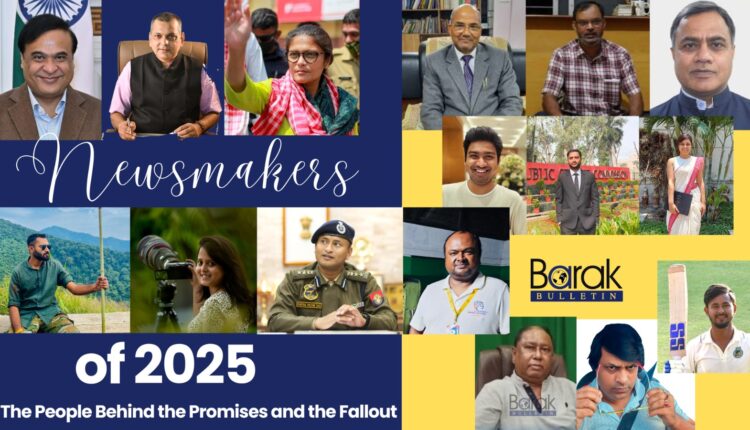
Barak Valley’s Newsmakers 2025: The People Behind the Promises and the Fallout

2025 did not lack headlines. It lacked consequences. Too many wrongs became “updates”, too many warnings became “rituals”, and too many public offices behaved as if outrage was a weather report: loud, brief and forgettable.
Barak Valley deserves better. Leaders who sign orders must own outcomes. Police stations must be places where citizens walk in with faith, not fear. Law and order is not a slogan for press conferences; it is the first promise of the state. When crime spreads and justice slows down, society does not merely suffer, it learns the wrong lessons.
But discourse also needs repair. We have normalised cruelty in comments, casual hate in conversations, and cynicism as intelligence. We need a sharper civic vocabulary: one that questions power without losing humanity, that debates fiercely without turning neighbours into enemies.
And while we argue, a generation is growing up watching us. If India at 2047 is to be confident, competent and kind, children must be pulled into activities that build character: sport, reading, science clubs, music, volunteering, anything that teaches discipline and teamwork. Very little is being done in this regard in Barak Valley and that must keep the guardians awake at night.
Which brings us to our own disgrace. Cricket matches are happening everywhere, yet Silchar’s Satindra Mohan Dev Memorial Stadium is slipping into irrelevance, soon fit for hosting marriages only. A city that cannot protect its playgrounds cannot claim to be building a future.
Yet 2025 was not only a year of decay; it was also a year of proof. Proof that Barak’s students can compete and win. Proof that quiet excellence still exists in our classrooms, hospitals, laboratories and homes. Proof that ordinary citizens, teachers, volunteers, rescuers, sportspersons, can hold the line when systems wobble. If we protect our institutions, demand accountability without fatigue, and rebuild our civic habits with kindness and discipline, Barak Valley can still rise. The future is not a gift. It is a daily decision and we can choose better, together.
These are the newsmakers of 2025: the people who shaped our year, for good or ill:
The shortlist is built from a blended scorecard: repeat presence across Barak Bulletin’s 2025 reporting, the weight of decisions taken (or avoided), verified public impact on lives and institutions, and measured audience response through reads, time spent, shares and debate quality. One-hit virality was discounted; sustained relevance was featured, consistently.
Himanta Biswa Sarma, CM, Assam
In 2025, Himanta Biswa Sarma remained the state’s most consequential headline-maker for Barak Valley—not by rhetoric alone, but by the churn of decisions and announcements that directly altered Silchar’s daily life. The flyover discourse became a recurring civic referendum: on planning, timelines, and accountability. His frequent visits to the region carried the weight of both promise and scrutiny, because every on-ground appearance raised one question—what changes after the convoy moves on? Development announcements under his watch shaped the valley’s political temperature, setting the agenda for what citizens demanded and what officials prioritised. In a year where governance often felt like theatre, Sarma’s actions still carried the power to define outcomes, making him unavoidable in the news cycle.
Professor Rajive Mohan Pant, VC, Assam University Silchar
Professor Rajive Mohan Pant makes the list because Assam University is not just a campus – it is one of Barak Valley’s defining institutions, shaping thousands of lives and the region’s intellectual credibility. In 2025, the university’s achievements and anxieties both sat in public view, and the Vice-Chancellor’s office inevitably became the focal point for questions of direction, governance, and accountability. Pant was a newsmaker because leadership in academia is not ceremonial; it is policy, priorities, and culture. Whether it was about rankings, administration, student confidence, or the university’s national standing, his role carried consequence. For Barak, a strong university is a development engine. A drifting university is a generational loss. Pant’s year mattered because the stakes were that high.
Kaushik Rai, Minister – Government of Assam
Kaushik Rai’s real political arc as a minister unfolded in 2025, and it did so with an unmistakable assertion of influence. The Panchayat elections were not just a local contest; they became a theatre of power, and Rai was at its centre – organising, shaping the narrative, and expanding his footprint in public discourse. The moment a candidate thanked him while calling him the “CM of Barak Valley” may have been a slip of tongue, but it revealed a larger truth: perceptions of authority do not form in a vacuum. They form when a leader becomes the visible face of access, action, and delivery. In a region hungry for stable representation, Rai emerged as a decisive operator – admired by supporters, tested by critics, but undeniably prominent.
Professor Debashish Bhattacharjee
Professor Debashish Bhattacharjee became a newsmaker because his survival story forced the country to confront the human anatomy of terror. Barak Bulletin was among the first to report, on the very day of the attack, how he escaped the terrorist assault in Pahalgam, Kashmir – and how, in those moments, the attackers were allegedly asking people to recite the Kalma. Once that detail entered the public record through our reporting, it ignited a national discourse and drew international attention, not as a talking point, but as a chilling insight into the targeting and theatre of hate. Bhattacharjee returned to Silchar with his wife and son—alive, but not unscarred. What followed was equally revealing: alongside empathy came a wave of trolling from fringe elements, exposing how quickly compassion collapses when prejudice is invited to speak.
Sushmita Dev, MP, Rajya Sabha
Sushmita Dev’s relevance in 2025 lies in a political paradox: though she entered the Rajya Sabha from Bengal on a TMC nomination, she remained one of Barak Valley’s clearest opposition voices. At a time when dissent is often reduced to noise, she carried counter-opinion into Parliament with persistence – and that matters more when local opposition looks depleted. With the Congress in flux and Kamalakhya Dey Purkayastha openly exploring new alignments, the valley’s anti-incumbency voice risks slipping into an abyss. Dev’s prominence, therefore, is not only about what she said, but what she represented: a channel for protest, scrutiny, and alternative narrative at the national level. In a democracy, opposition is not an inconvenience. It is insurance. Her presence kept that insurance alive, albeit in ventilation.
Pulak Malakar – the arrest that led to exposing the racket of fake doctors
Pulak Malakar became a newsmaker because his case shook the most sensitive pillar of any society: trust in healthcare. The “fake gynaecologist” scandal was not merely a crime story; it was a public wound – forcing families to ask how easily credentials can be faked, how oversight can fail, and how long warning signs are ignored until harm becomes irreversible. The outrage around the case was visceral because it dealt with intimate care and vulnerable patients, where consent and competence are non-negotiable. Malakar’s name came to symbolise a larger civic fear: that institutions meant to protect can become complicit through neglect. In 2025, the story demanded not just arrests, but reforms – verification, accountability, and a public health system that does not leave citizens to gamble with their bodies.
Partha Pratim Das (SSP, Cachar)
Partha Pratim Das makes the list because 2025 tested law and order in Cachar repeatedly – and the SSP’s office became the visible face of the state’s response. In a year where crime stories were not isolated incidents but recurring anxieties – rackets, violence, contraband, intimidation – citizens measured the administration by two things: speed and seriousness. Das’s interventions, briefings, and actions shaped how the public interpreted safety: whether policing was proactive or reactive, whether investigations had direction or drift. The SSP’s role is rarely glamorous, but it is foundational; when enforcement appears weak, society hardens into cynicism and vigilante instincts. Das was therefore a newsmaker not because policing was perfect, but because policing became central to the valley’s everyday conversation – about fear, justice, and the rule of law. How his investigating officers’ case diaries stand the scrutiny of the law to ensure no easy bails are handed out and how he deals with moral policing incidents, are aspects that remain to be followed in 2026.
Dr J. P. Das – the alleged mastermind running the fake-doctors’ nexus
Dr J. P. Das became a newsmaker because the alleged “fake doctors” network, as reported by police, exposed an ecosystem-level threat – one that cannot be dismissed as a single bad actor. His name, positioned as a key node in that alleged racket, drew attention because it represented something far more terrifying than petty fraud: the possibility of organised deception inside an arena where mistakes cost lives. The case raised uncomfortable questions about gatekeeping, enforcement gaps, and the ease with which authority can be mimicked in smaller towns. It also pushed a necessary civic conversation – what does due diligence look like for hospitals, clinics, and regulators? In 2025, this story forced Barak to confront a bitter truth: when institutions fail to verify, ordinary citizens become collateral. The fact that he is an established mastermind of turning hospitals into potential crematoriums, makes him a newsmaker.
Dr Nabodyuti Das
Dr Nabodyuti Das became a newsmaker for the best reason possible: he gave Barak Valley a story of global competence rooted in local beginnings. His journey – from Sribhumi earlier known as Karimganj, to a Marie Curie Fellowship – did not read like distant academic achievement; it read like proof that world-class work can emerge from the margins, even when infrastructure and exposure are uneven. In a year crowded with scandal and cynicism, his profile offered something rarer than inspiration: a credible pathway. It mattered to students and parents because it shifted the mental map of what is possible, and it mattered to the wider public because it challenged the lazy stereotype that excellence only comes from metropolitan pipelines. In 2025, he became a symbol of Barak’s unrealised potential – and a reminder that talent needs support, not sympathy.
Abhishek Thakuri, cricketer – suspended for alleged involvement in corruption
Abhishek Thakuri became a newsmaker because 2025 turned one of Barak Valley’s proudest sporting names into its most painful headline. Once the captain of Assam’s age-group sides, he was long spoken of as the state’s finest wicketkeeper-batter—an on-field masterclass in temperament and timing. He even underlined that pedigree with a Ranji Trophy century as recently as last season, the kind of performance that should have sealed his legacy as a local standard-bearer. Instead, this year delivered a disgrace: the Assam Cricket Association banned him over allegations that he attempted to manipulate players and pushed spot-fixing during the Syed Mushtaq Ali Trophy. For Barak, it was not merely a fall from grace; it was a warning about what happens when ambition outruns ethics. His name became shorthand for a larger sporting crisis – talent without strong systems, and a culture that keeps producing matches but not values.
Hrishiraj Bhattacharjee, founder of Team Karimganj
He earns a place in Barak Bulletin’s Newsmakers because he represents Barak’s most under-covered story: enterprise that travels beyond geography. From Karimganj, he has built Team Karimganj into an export-facing tech services outfit in OSINT, intelligence and cyber-adjacent work – an improbable category for a town rarely mapped into India’s “new economy”. But this is not symbolism; it is jobs, capability and the audacity to compete globally while hiring locally. His own trajectory sharpens the point: a B.Tech from NIT Silchar followed by post-graduation at King’s College London – a blend of local roots and global rigour that he has channelled back into the valley. In a region where ambition is often forced to migrate, he has tried to make opportunity stay. That shift matters. It changes what young people believe is possible – and it challenges Barak to take entrepreneurship seriously.
Trikal Chakraborty, Wildlife Enthusiast
Trikal Chakraborty makes the Newsmakers list because he has become Barak Valley’s most visible, dependable face of wildlife response—showing up where panic gathers, and turning it into procedure. Across repeated rescues of highly venomous snakes, he has done more than “save” animals; he has quietly trained a city to behave better—less mobbing, fewer reckless kills, more respect for safety and ecology. His relevance is consistency: this is not one dramatic reel, but a sustained civic service in a region where formal systems often arrive late. In 2025, his work reinforced a simple truth: public good is not only made in offices and assemblies; sometimes it is made on a roadside, with a hook-stick, steady hands, and zero appetite for applause.
Rajeshori Dey – designed the garment that was donned by the President of India
Rajeshori Dey belongs on the Newsmakers list because her work gave Silchar a rare moment of national cultural visibility without controversy – pure craft. When the President of India draped a saree designed by this young textile designer from Silchar at the Vice President’s swearing-in ceremony (September 2025), it was not a social-media gimmick; it was a quiet validation of skill, taste and labour from the margins. In a region that often measures success only through exams and elections, Dey’s inclusion expands the definition of achievement: creative industry, design as livelihood, and Barak’s talent entering formal national symbolism.
Vikash Yadav – secured AIR 25 in UPSC Engineering Services Examination
Vikash Yadav is a newsmaker because he represents Barak Valley’s most consistent, underrated story: disciplined ambition fighting scarcity. Securing AIR 25 in the UPSC Engineering Services Examination (2025) is not only personal success – it is a signal to hundreds of households that high national outcomes can come from Bariknagar, Silchar, without metropolitan privilege. What strengthens his case is continuity: he has cleared the same exam earlier too, proving this is not a lucky year but a sustained standard. In a time when public conversation is crowded with scandal and spectacle, Yadav’s journey re-centres merit, grit, and the value of long preparation. He is on this list because he moved the morale needle – and because he made aspiration feel local, practical and attainable.
Professor Alok Tripathi led ASI’s Underwater Archaeology Wing in expeditions at Dwarka and Beyt Dwarka
Professor Alok Tripathi deserves a place because he turned an Assam University academic identity into a national scientific headline. Leading ASI’s Underwater Archaeology Wing in expeditions at Dwarka and Beyt Dwarka, his work sits at the intersection of heritage, science and state capability – exactly the kind of “knowledge economy” leadership Barak Valley rarely gets credited for. This was not armchair scholarship; it was fieldwork: dives, documentation, and systematic study in one of India’s most symbolically charged coastal sites. The fact that he led teams undertaking exploration and related training activity at Dwarka only strengthens the point – he is building capacity, not just collecting prestige. In 2025, Tripathi made Barak visible in a domain where the country usually looks elsewhere: serious archaeology, serious institutions, serious national attention.
Salma Sultana (Silchar-born wildlife biologist and filmmaker)
Salma Sultana makes the Newsmakers list because her work carried a Barak Valley name into a global conservation conversation – without noise, without patronage, and without dilution. Barak Bulletin reported how her documentary Chasing Birds won global recognition at the Yale Environment 360 Film Contest, and how she described the honour as “surreal and deeply moving”. The film’s strength lies in its gaze: it tells an Assamese story with patience and moral clarity, following a life shaped by conflict and poverty, yet pulled towards nature and redemption. In a year when the public sphere often rewarded outrage, Sultana’s recognition reminded us that serious storytelling still travels—especially when it is rooted, researched, and humane. And for Barak, that matters: it expands what local success can look like.
Editor’s note and listing by: Anirban Roy Choudhury on behalf of Jnanendra Das, Ahadul Ahmed, Saumen Paul, Rohit Dey, the founders – Ashish Purkayastha, Archana Bhattacharjee, Adwoy Purkayastha, the entire team and management of Barak Bulletin and the millions of readers.
Wishing you a happy new year: 2026
Comments are closed.