
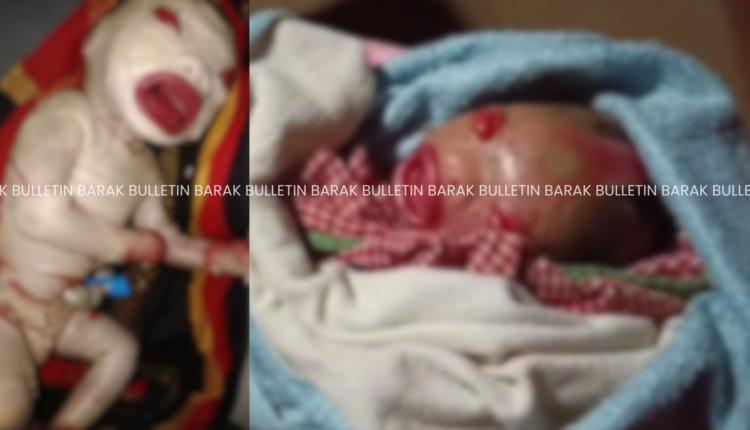
Newborn Born With Rare Harlequin Ichthyosis Genetic Disorder In Borkhola

A newborn born with a rare genetic disorder triggered widespread curiosity in South Seuti village under Bhangarpar GP in Borkhola constituency of Cachar district on Saturday (April 18). The baby was delivered at Bikrampur Ramkamal Primary Health Centre on Saturday morning to Nazmul Hussain and Zarina Begum. Doctors say this to be Harlequin ichthyosis, a severe, rare genetic skin disorder.
Soon after birth, medical staff reportedly noticed severe skin abnormalities and multiple health complications. As news spread, large numbers of people gathered outside the family’s residence, creating a commotion in the area.
Doctors at Bikrampur hospital said the child is suspected to be suffering from Harlequin Ichthyosis, a rare congenital genetic skin disorder present at birth. “This is not something to be scared of. It is a congenital condition called Harlequin Ichthyosis, and not an entirely new phenomenon. Prenatal screening is very important in such cases. Since this case is from a remote area, the expecting mother may not have undergone regular prenatal screening during pregnancy, which is why the condition did not come to light earlier. Following due procedure, we have referred the baby to Silchar Medical College and Hospital for special care,” doctors said.
Dr Priyanka Deb (MBBS, MD Pediatrics), a renowned child specialist of Silchar, said, “Harlequin ichthyosis is a rare and severe genetic skin disorder present at birth.”
She added, “Babies are born with very thick and hard skin plates with deep cracks or fissures tightening the skin, that can pull the eyelids outward (ectropion) and lips outward (eclabium). Flattened ears or nose also appear, and difficulty moving arms, legs and fingers are observed.”
Explaining the cause, Dr Deb said, “It is a genetic disorder caused by mutation of the ABCA12 gene and inherited in an autosomal recessive pattern, meaning both parents carry the gene.”
She further warned that the condition can cause breathing trouble, feeding difficulty, dehydration, infection risk and temperature regulation problems, requiring urgent neonatal intensive care, including a Humidified incubator, skin softening ointments or emollients, careful nutrition, infection prevention and sometimes oral retinoid medicines.
When asked whether the condition can be prevented and how important prenatal screening is, Dr Deb said, “Harlequin ichthyosis can sometimes be detected antenatally (before birth), especially when there is a known family history or suspicion from ultrasound findings.”
She said, “The most accurate method is genetic testing. If parents are known carriers or have had a previously affected child, Chorionic Villus Sampling (CVS) between 10 to 13 weeks or amniocentesis between 15 to 20 weeks can analyse the ABCA12 gene mutation, which is responsible for harlequin ichthyosis.”
Dr Deb added, “Routine anomaly scans may sometimes show signs later in pregnancy, usually during the second or third trimester. However, ultrasound alone may miss early or mild cases, so genetic testing is more definitive.”
On future pregnancies, she said, “If there was a previously affected baby, future pregnancies should involve preconception genetic counselling, early targeted prenatal testing and detailed fetal medicine scans.”
Summing up, Dr Deb said, “Yes, antenatal detection is possible, especially through genetic testing. Ultrasound may suggest it, but DNA testing confirms it. We can help prevent this through proper genetic testing and counselling pre-pregnancy.”
The newborn has been referred to Silchar Medical College and Hospital for advanced treatment.
Comments are closed.