
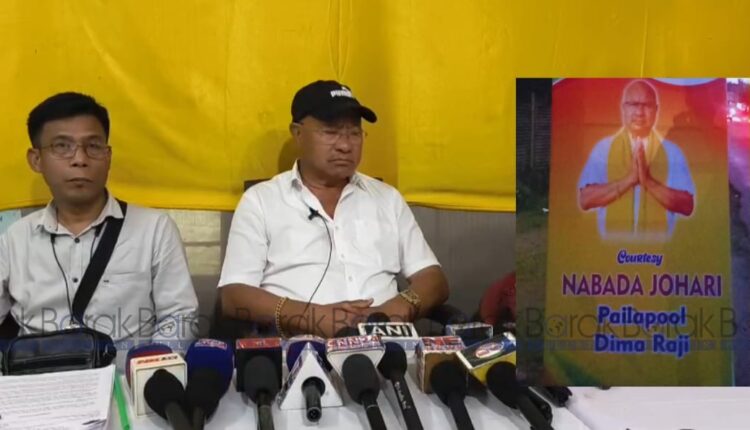
‘Dimaraji’ Gate was Cultural, Not Political, says Nikhil Cachar Haidimba Barman Samiti

Amid the controversy over a temporary welcome gate bearing the words “Poilapool Dimaraji”, the Nikhil Cachar Haidimba Barman Samiti (NCHBS) on Saturday (June 27) clarified that the term “Dimaraji” is purely a cultural expression meaning “Dimasa village” and has no political, territorial or constitutional implication.
Addressing the media, NCHBS leaders said the temporary gate was erected at Poilapool to welcome local MLA and Assam Cabinet Minister Kaushik Rai during his first visit to the area. They said they never expected the use of the word “Dimaraji” to become the subject of controversy.
Speaking to reporters, Nabda Barman said “Dimaraji” simply means a Dimasa village or settlement in the Dimasa language and was only meant to signify the presence of a Dimasa village at Poilapool.
He said similar usage exists elsewhere and should not be viewed with suspicion. “Even a Dimasa colony in Delhi would write ‘Dimaraji’. It means nothing more than a Dimasa village,” he said. He added that if the gate had read “Dimaraji Dima Hasao”, people might have interpreted it differently, but the gate clearly referred to “Poilapool Dimaraji” and did not suggest any territorial claim.
Another speaker echoed the same point, saying there are places known as “Delhi Dimaraji” and “Guwahati Dimaraji”, but that does not mean those places belong to the Dimasa community. He said the term is part of their cultural identity and should not be linked to politics.
Referring to organisations or individuals who may have political demands related to “Dimaraji”, including those who have taken up arms in the past, he said their agendas were separate and had nothing to do with the Poilapool welcome gate. He maintained that the present issue was purely cultural.
The speakers also expressed concern over what they described as the declining population of the Dimasa community and the gradual loss of its language and traditions. They said highlighting their culture and identity is important to preserve the community for future generations.
Earlier in the day, the NCHBS also issued a press statement expressing concern over what it described as sensationalised and misleading reports by certain media outlets and social media platforms regarding the welcome gate.
The organisation stated that “Dima” refers to the Dimasa people while “Raji” means village or settlement in the Dimasa language. It said the expression “Dimaraji” reflects the indigenous identity, historical presence and cultural heritage of the Dimasa people and carries no political, administrative, territorial or constitutional implication.
The Samiti alleged that certain individuals and organisations had assigned unwarranted meanings to the expression, creating confusion, fear and social disharmony. It maintained that peacefully displaying a traditional cultural expression is protected under the Constitution of India and should not be misconstrued as a political statement or a challenge to existing administrative arrangements.
The organisation appealed to media houses, community leaders, organisations and citizens to avoid spreading misinformation or making provocative statements that could disturb communal harmony in Lakhipur and the Barak Valley. It also urged the civil administration and law enforcement agencies to remain vigilant against any attempt to create misunderstanding over what it described as a purely cultural issue.
The NCHBS further reaffirmed its commitment to peaceful coexistence, mutual respect and communal harmony while stating that the Dimasa community would continue to preserve and promote its historical, cultural and indigenous identity.
Comments are closed.