
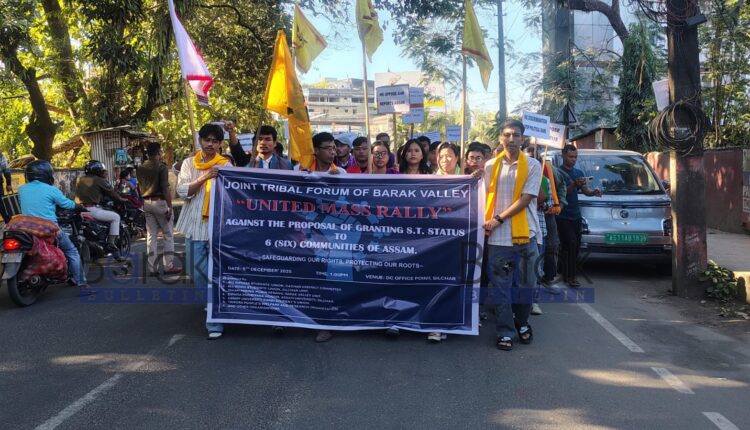
United Mass Rally in Silchar Opposes Proposal to Grant ST Status to Six Communities

A united mass rally was held in Silchar on Friday (December 5) in strong opposition to the proposal to grant Scheduled Tribe (ST) status to six communities of Assam. Several tribal student bodies and community organisations of Barak Valley participated, stating that the proposed move could affect their existing constitutional rights and representation.
The rally at the call of All Dimasa Students’ Union, saw participants from Dimasa, Bodo, Mising, Karbi and Tripuri organisations. The gathering of more than 500 marched from Dimasa Sanskriti Parishad Bhawan at PWD Road to Narsinghtola Ground. They later submitted a memorandum addressed to the District Commissioner, which was received by Magistrate Anjali Kumar on behalf of the DC. The groups said their concerns needed urgent attention from the government.

The rally was jointly organised by the All Dimasa Students’ Union of Cachar District, the All Bodo Students’ Union of Silchar, Takam Mising Porin Kebang of Barak Valley, Dimasa Phoriyasa Hosom of Assam University, the Karbi Students’ Union of Assam University, the Tripura People’s Welfare and Research Organisation and several Dimasa community organisations. Members of these groups said the proposal could change the socio political balance in Assam.
Speaking to the media, David Thaosen, Advisor of the All Dimasa Students’ Union, said that Scheduled Tribe status is a constitutional identity and not something that can be granted simply on demand. He said their population is small and that adding more than one crore people to the category would create major problems for their community. He urged the government to protect Assam, follow the Assam Accord and avoid decisions that could reduce their representation.
Thaosen also said that granting ST status to new communities will not solve the issues faced in Assam. He added that the government should focus on forming the right policies rather than taking hasty steps. According to him, the inclusion of the six communities may create further socio political tensions and affect the rights of those who already belong to the Scheduled Tribe category.
A young representative of Bodo student body at the protest said that they consider themselves the original Scheduled Tribe communities of the region. He said their history and struggles are deeply connected to the land and that the proposed communities are more advanced and modern than them. According to him, these communities do not require ST status and already have better access to resources and opportunities.
The young representative also spoke about the discrimination they allegedly face from some people of the six proposed communities. He said they are sometimes viewed as barbarians and that such attitudes show the difference in social conditions. He urged the government to visit their villages to understand their hardships and see what poverty and disadvantage truly look like.
Recently the Assam Cabinet recommended ST status for six major communities. These communities are Tai Ahom, Chutia, Koch Rajbongshi, Matak, Moran and the Tea Tribes or Adivasis. Their demand for inclusion has continued for decades and the cabinet’s decision was seen as a major step in addressing their long standing appeal for recognition and support.
However, the decision has not been accepted by the existing ST communities in Barak Valley. Their rally on Friday was a clear expression of disagreement and members of various groups openly made statements against the move. Community leaders said they fear that their identity, rights and access to opportunities will be affected if these six communities are added to the ST list.
In India, Scheduled Tribe status is a constitutional recognition given to communities that have historically faced social, economic and educational disadvantages. It is meant to protect vulnerable tribal groups and ensure they receive support through reservations in education, employment and political representation. The purpose of granting ST status is to promote equality by helping these communities overcome long standing barriers, preserve their cultural identity and gain fair access to opportunities for development.
Comments are closed.