
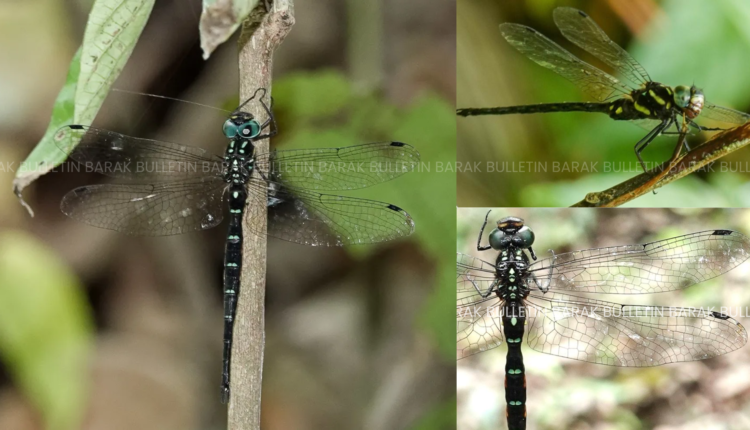
New Dragonfly Species Discovered In Sribhumi, Named After Dosdewa

A hospital-run biodiversity club from Assam’s Sribhumi district has contributed to the discovery of a new species of dragonfly previously unknown to science. The species Long-tailed Boghawker (Sarasaeschna dosdewaensis) is named after the remote forest village of Dosdewa and was officially described in a research paper published on April 21, 2026, in the peer-reviewed international journal Zootaxa.
The discovery is a part of three new species of dragonflies in Northeast India, including two from a remote valley in Arunachal Pradesh and one from Dosdewa in Sribhumi. The research team comprised Shantanu Joshi, Krushnamegh Kunte, Dattaprasad Sawant, Ujwala Pawar, Fahim Khan, Rejoice Gassah and Vijay Anand Ismavel.
The new species Sarasaeschna dosdewaensis was discovered at the Dosdewa Forest Trail in Dosdewa Khasi Punjee, a forest village under the Patialla Beat of the Lowairpoa Range near the Mizoram and Tripura borders. According to the published paper, the holotype male specimen was collected from the trail on June 3, 2020.
The discovery is linked to the efforts of Makunda Nature Club and local biodiversity enthusiasts from Dosdewa. Rejoice Gassah, a resident of Dosdewa village who photographed and collected the species, played a key role in the finding. He heads the biodiversity department at Makunda Christian Leprosy and General Hospital in Bazaricherra and is associated with the Makunda Nature Club. Dr Vijay Anand Ismavel, the founder of the club and hospital superintendent, was among the contributors to the research.
Dr Vijay Anand Ismavel said, “A new species of dragonfly, previously unknown to science, has been discovered at Dosdewa village, 65 km from Sribhumi town, by Rejoice Gassah. The new species, Sarasaeschna dosdewaensis, named after the village, is one of three new species described in the article.”
Writing to Barak Bulletin, he added that the forests of Sribhumi district, especially areas close to the Mizoram and Tripura borders, are rich in biodiversity but face threats from deforestation and wildlife trapping. “Studies like this one will strengthen the cause of conservation,” he said.
Four years ago, another new species of ghost moth was discovered by Dr Vijay Anand Ismavel, superintendent of the Makunda Christian Hospital and founder of the Makunda Nature Club. The moth was named Endoclita makundae (after the hospital where it was found).
Dr Ismavel said, “These discoveries, as well as the reporting of many rare species of birds such as the Cachar Bulbul, Siberian Blue Robin, Asian Stubtail, van Hasselt Sunbird, as well as other life forms by the Makunda Nature Club, have greatly enhanced the understanding of wildlife in this remote location”.
The work of biodiversity documentation and research not only supports conservation but also provides an opportunity for ecotourism. The Dosdewa Forest Trail, started by Rejoice Gassah and developed by the villagers of Dosdewa, attracts a large number of birders from all over the country who come to spot species rarely seen elsewhere. It also employs villagers who provide pick-up and drop-off, homestay and guide services to the visitors.
Dr Ismavel also told us that the Makunda Nature Club has contributed the largest number of observations to iNaturalist, the world’s largest citizen science portal and to the Assam Biodiversity Portal from the state, improving the body of knowledge on these life forms from a remote part of the state.
Dosdewa village remains cut off from Patialla during the rainy season due to a lack of proper road connectivity. Despite this, the area has emerged as a biodiversity hotspot and is gaining recognition among birdwatchers and wildlife enthusiasts. The Dosdewa Forest Trail attracts visitors from across the country for sightings of rare birds and other wildlife.
The discovery highlights the ecological richness of southern Assam and the growing role of citizen scientists and local communities in documenting species from remote regions.
Comments are closed.