
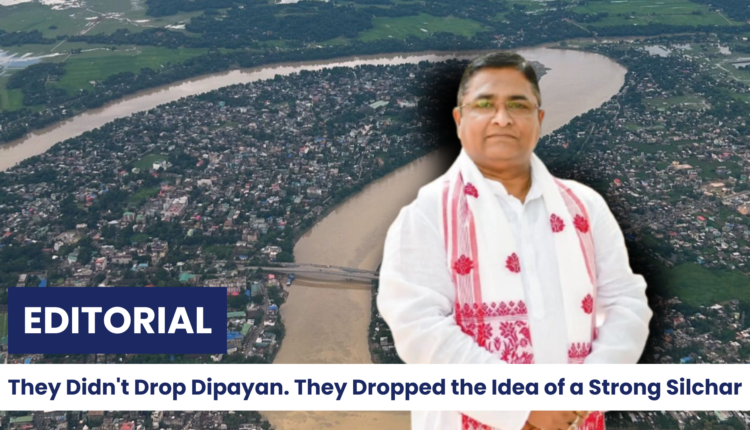
They Didn’t Drop Dipayan. They Dropped the Idea of a Strong Silchar
Dipayan Chakraborty had ego – the sort that comes from Brahmanical supremacy. But he was not communal, despite being in an environment that was. A grassroots BJP boy who became a man, a leader, by daring to contest against the ‘Devs’ in Tarapur – a bastion of the Congress or the Devs. He got the ticket to contest from Silchar and won, becoming the MLA in 2021. The ego mounted into high-handedness. The high-handedness drove him to have people arrested on whims and fancies. He once got his own neighbourhood boy arrested for an innocuous Facebook post; on another occasion, an old, grey nightwatchman. The list is long. But those were his early days.
As he grew into his tenure, he had more matter than moments to talk about. His campaign slogan was – “Master Drainage Korbe Ke, Dipayan Chara Aar Ke.” The master drainage promise remains unfulfilled, yet the drainage has never been as functional as it is today. The Khaals (natural drainage channels) have never been as wide. The District Library is a grandeur nearly complete, and the roads in the lanes and bylanes are at their best. There is a lot that Dipayan Chakraborty has not done, but there is a lot that he has. He could.

So why the snub? The Bharatiya Janata Party announced its list of candidates, and the incumbent Silchar MLA has been asked to make way for former Silchar MP Dr Rajdeep Roy – son of former MLA Bimolangshu Roy. What does this snub essentially mean?
The shortest answer is: nothing. The electorate of Silchar, over the last decade, has established that it votes for the party, not the candidate. What was once intended as mockery has now become a matter of pride for the voters – “If a banana tree contests on a BJP ticket, the tree will emerge victorious.” The fact of the matter is, only monkeys vote for a banana tree. Human beings shouldn’t.
The longer answer requires more detail. Silchar is the hub of Barak Valley and, therefore, the headquarters of the Bengalis in Assam. A strong Silchar represents the strength of Bengali culture, embodies its heritage, and stands as the ambassador of the Bhasha Andolan of May 19, 1961, when eleven martyrs laid down their lives in Silchar protesting the imposition of Assamese across the state. That was a direct assault. The latest efforts are far subtler: reduce the number of Legislative Assembly constituencies, reduce the number of ministers from Cachar district, amplify non-Bengali representation, and fracture the foundation.
Dipayan Chakraborty was just about growing into that strength as a leader. He had little to lose. No enterprise mortgaged to political patronage, no borrowed time on which interest was accumulating. Such men are dangerous to those who prefer their representatives grateful.
Dr Rajdeep Roy is not a weak man. In 2019, he defeated Sushmita Dev (Silchar LS) – a formidable opponent from a formidable political family – by a margin exceeding 80,000 votes. He carries a name that still means something in Barak Valley. But he arrives in this election as a choice made in Dispur, not in Silchar. And Silchar, which once made its own choices, is being asked to ratify a decision it was not consulted about. That is the real meaning of the snub – not the demotion of one politician, but the continued, patient diminishment of a constituency’s right to determine its own representation.
The opposite of strength is weakness – and weakness was laid bare when devastating floods struck Cachar district in 2022. The Chief Minister of Assam visited, accompanied by two other MLAs from Barak Valley, and one of them chose the moment to mock: “Silchar or MP MLA Bilak Kaam Kora Nai.” Search “Eman Khong” and you will find the video. When Bimolangshu Roy was the MLA, no one would have dared to mock in this manner. That was strength. A strong Silchar would not have allowed two legislative assembly seats to be excised – a delimitation that wipes out the heart and soul of the constituency. A strong Silchar would not let Dispur alone call the shots. And that is precisely why a strong Silchar is inconvenient to those who wish to dictate terms from Dispur.
Moinul Hoque Choudhury, Santosh Mohan Dev, Bimolangshu Roy, Kabindra Purkayastha – they did not let Dispur dictate. They stood straight and looked it in the eye. That resolve delivered the Medical College, the University, the Engineering College, the Paper Mill, Doordarshan, the Radio Station, the Sugar Mill, the Deodhar Trophy match, the India Women vs England Women international fixture – and the list goes on. Those matter more than Rs 1,200 a month deposited into an account.
On March 19, 2026, posts across social media platforms announcing Dipayan Chakraborty’s exit and Dr Rajdeep Roy’s nomination provoked an overwhelming reaction. Ninety per cent expressed anger at Chakraborty’s snub; five per cent mocked Dr Roy; five per cent welcomed him. It is worth remembering that in 2019, Dr Roy defeated Congress’s Sushmita Dev by a historic margin of over 80,000 votes. He is by no means a weak candidate. But people remember the road not taken.
That boy did not deserve to be arrested for a Facebook post. Dipayan Chakraborty did not deserve to be snubbed from a second term. These are not equivalent injustices, and the comparison is not made to suggest they are. It is made to acknowledge something simpler and more durable: that the things we do not deserve have a habit of happening to us regardless, and that the appropriate response is neither resignation nor rage, but clarity – about what was lost, why it was lost, and what it will cost to recover it.
Silchar knows what it has lost before. It has, on occasion, found the will to demand it back.
The question is whether it still can.
Comments are closed.