
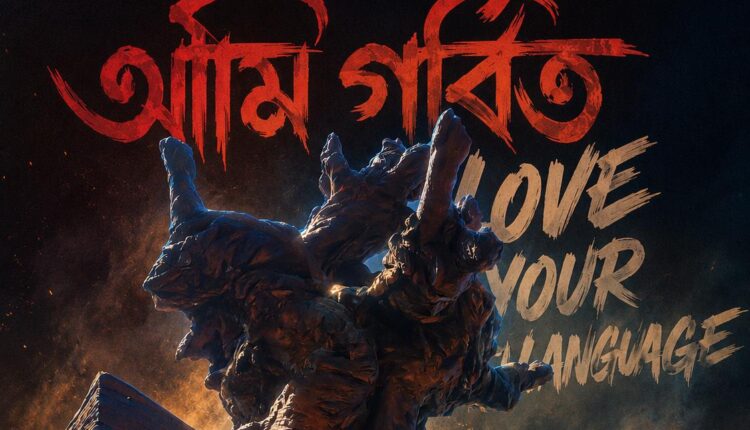
Identity beyond binary: How 21st February & 19th May reimagined identity through language

By: Shaqib Chowdhury
The language movements in Dhaka and Barak Valley reveal how identity in the Indian subcontinent extends far beyond religion and caste.
It’s 19th May, 1961, and the morning air in the southern part of Assam is engulfed with Rabindrasangeet and Nazrulgeeti. The protestors gathered in large numbers and blocked the railway track. By 2:30 PM, anti-government slogans filled the air, and, suddenly, a rain of bullets started to shower on the protestors at Silchar railway station, causing nine people to die on the spot and two more later. The violent crackdown also left more than 100 people injured. Their demand was simple: recognition of the Bengali language as an official language of Barak Valley.
The language movement in the Barak Valley remains one of the earliest and most significant language movements in post-independence India. Yet, outside Assam, the incident rarely finds a space in mainstream history textbooks or public memory. The silence surrounding it reflects something deeper about how identity has been understood in the country since independence.
The partition of the subcontinent reduced human beings into religious categories. Borders were drawn along the religious lines, and millions of lives and homes were uprooted overnight. In the decades that followed, electoral politics further narrowed identity into manageable binaries. Religion and caste became the dominant lenses through which communities are viewed, mobilised, and divided.
Today, if one asks what identity means in the entire subcontinent, the immediate answers are likely to be religion and caste. But identity is far more layered than electoral vocabulary. Language is one of the deepest forms of shared identity. It carries memory, geography, lullabies, folklore, grief, resistance, and love across generations. A language doesn’t merely help people to communicate; it shapes the way they experience the world. The tragedy of modern politics is that linguistic identity is often treated as a secondary identity, even though language governs the most intimate parts of human life.
People of different faiths perform their religious rituals in liturgical languages. But when people speak to their Gods in moments of pain, fear, gratitude, and hopelessness, they return to their mother tongue. One cries, prays, and dreams in the language learned from one’s mother.
On 21st March, 1948, when Mohammed Ali Jinnah declared in Dhaka that “Urdu, and only Urdu, shall be the state language of Pakistan.” The move triggered widespread protests by students, intellectuals, activists, and ordinary Bengalis in East Bengal – then East Pakistan. The demand was for the inclusion of the Bengali language as an official language. The movement was intensified, resulting in the death of five students and over a hundred casualties in Dhaka on the premises of Dhaka University. Now, the day is observed globally as Mother Language Day by UNESCO.
The reduction of identity into religious categories creates another dangerous simplification – the assumption that every religious community speaks in one uniform language. In popular imagination, Muslims are often associated with Urdu and Christians with English. But the lived reality of these communities is far more complex. A Bengali Muslim from Assam and Bengal inherits different folklore, food habits, oral traditions, and literature from Hindi/Urdu-speaking Muslims from Northern India. Similarly, a Malayalam Christian carries a vastly different cultural memory from North Eastern Christians. Their religion may be shared, but their emotional worlds are shaped profoundly by language and region.
To associate an entire community with a single language is to reduce millions of people into neat categories that history itself refuses to accept. Language is not confined by religion; it travels through bedtime stories, local idioms, songs sung during storms, jokes shared in marketplaces, and the words whispered by grandparents across generations. It creates bonds between people of different faiths and castes, and also becomes a source of political strength and resistance. That is why Bengali Muslims of East Bengal found the courage to resist the attempt by the Urdu-speaking Muslim ruling elite of West Pakistan to impose a single language upon them. And perhaps why, years later, Bengalis of the Barak Valley, carrying Rabindrasangeet and Nazrulgeeti on their lips, walked onto the roads and stood before the bullets to defend their language against linguistic imposition.
In an era where identities are increasingly polarised and simplified, 21st February and 19th May compel us to rethink what identity means in the Indian subcontinent. Identity doesn’t exist through a singular marker; it exists through overlapping identities. They remind us that language is a vessel of memory, belonging, and collective humanity. And that’s why linguistic identity will always matter.
Comments are closed.