
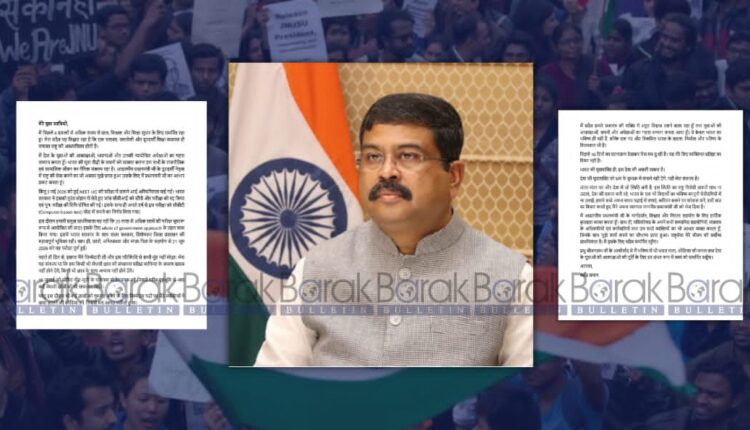
Union Education Minister Dharmendra Pradhan Resigns Amid Nationwide Student Protests

Union Education Minister Dharmendra Pradhan announced his resignation on Saturday (July 25), bringing a dramatic halt to weeks of intense student agitation across India. His departure follows the recent NEET-UG examination controversies and the high-profile “Chalo Sansad” march organized by the Cockroach Janta Party (CJP).
In a two-page resignation letter addressed to Prime Minister Narendra Modi, Pradhan stated that he chose to step down to protect the future of students from legal entanglements and to prevent anti-social elements from exploiting the situation at Jantar Mantar. He expressed gratitude for the opportunity to serve under the Prime Minister and emphasized that national service remains his highest priority.
The protests, which began after irregularities surfaced in the May NEET-UG examination, quickly transcended the capital. While demonstrations initially centered around Jantar Mantar in New Delhi, the movement rapidly evolved into a pan-India outcry. Rallies and protests demanding his resignation erupted in multiple cities, including Patna in Bihar, Mumbai in Maharashtra, across West Bengal, Assam, and Mizoram. Students had also scheduled a demonstration in Silchar for this Sunday, though it is likely no longer necessary following Saturday’s resignation.
The crisis intensified on 20 July during the “Chalo Sansad” march, when clashes broke out between protesters and security forces near the Press Club of India. The confrontation drew widespread national attention, widespread solidarity marches, and interventions from prominent figures such as climate activist Sonam Wangchuk, who maintained a lengthy hunger strike.
Following the examination leaks, the government moved the NEET-UG probe to the Central Bureau of Investigation (CBI), canceled the disputed test, and announced plans to shift the examination to a computer-based format by next year. The National Testing Agency (NTA) also carried out a major internal purge, dismissing 47 officials.
Pradhan concluded his letter by thanking ministry officials, colleagues, and the people of Odisha, stating that he will continue to support the aspirations of the nation’s youth in the future.
The sharp contrast between Pradhan’s earlier media remarks and his exit note highlights a notable shift in tone regarding the student movement. During the peak of the agitation, the outgoing minister had publicly dismissed the protesting groups and the Cockroach Janta Party (CJP) as the “B-team of terror groups”, inviting severe backlash from student bodies.
However, in his final resignation letter addressed to the Prime Minister, he struck a vastly different posture, framing his departure as an effort to protect students from being manipulated by anti-social elements and to save their futures from legal entanglements. This pivot from branding demonstrators with aggressive political labels to assuming a protective guardian stance marks the concluding chapter of a turbulent tenure defined by unrelenting nationwide youth protests.
Comments are closed.