
A Hopeful Sign from Assam University: Four Juvenile Burmese Pythons Spotted on Campus Again

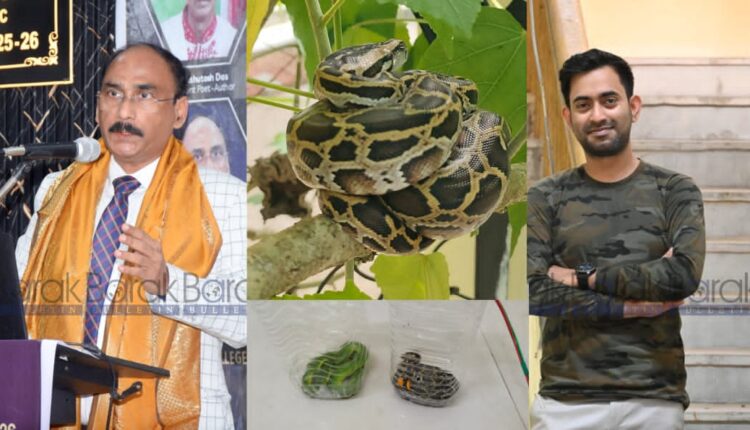
Four years after the first encouraging discovery during the Covid-19 period, Assam University has once again become the centre of a hopeful conservation story. Four juvenile Burmese pythons have been spotted at different locations inside the university campus, a discovery that experts believe reflects the continued survival of wildlife in one of Barak Valley’s richest green spaces.
The young snakes were recently noticed by Bishal Sonar, a research scholar from the Department of Ecology and Environmental Science. Based on their size and age, he believes the four juveniles were likely born to the same mother. The discovery has brought optimism to those who have been working to document and protect the university’s biodiversity.
Professor Parthankar Choudhury of the Department of Ecology and Environmental Science and former Dean of the E.P. Odum School of Environmental Sciences recalled a similar moment in 2022. During the difficult days of the Covid-19 pandemic, a Burmese python that was frequently seen within the university premises gave birth to four young ones.
“Among lots of despair, the good news was that a Burmese python frequently seen in the varsity area had given birth to four young ones,” he had shared at the time.
Now, with four juvenile Burmese pythons being found once again near the university gate and other parts of the campus, Professor Choudhury believes these snakes could be the offspring of that same python first recorded in 2022. While this cannot be confirmed with certainty, he described the discovery as another encouraging sign for the university’s wildlife.
Speaking to Barak Bulletin, Professor Choudhury said Assam University was fortunate to have been established in an area rich in natural biodiversity. Despite years of development and the concerns that such activities often bring about habitat loss, the continued presence of wildlife shows that many species are still managing to survive within the campus.
He said the university grounds are home to a remarkable variety of flora and fauna. According to him, the animals are also trying their best to remain within their natural habitat, reminding people that the campus is not meant only for humans but for all living beings. He stressed that coexistence is the philosophy they believe in.
The professor also highlighted the diversity found inside the campus, from colourful butterflies and countless insects to porcupines and even barking deer. He said protecting these species is essential for maintaining a healthy ecosystem.
To support conservation, the university has been documenting animals and birds found on the campus and creating awareness among students and staff. By helping people identify wildlife and understand its importance, the university hopes to ensure that these creatures are not harmed if encountered. Professor Choudhury believes the survival of these juvenile pythons is an example that such efforts are making a positive difference.
Research scholar Bishal Sonar echoed the same message. He said the presence of these young pythons is encouraging because it indicates that wildlife continues to survive despite challenges such as habitat disturbance and the threat posed by hunters. He noted that the region once even had rhinos, and while many species have disappeared over time, the continued presence of several wild animals is still something worth celebrating.
He emphasised that snakes play an important role in maintaining ecological balance and should not be feared without reason. He appealed to the public not to disturb them unnecessarily or perform dangerous stunts with them for photographs or videos.
The sighting of four juvenile Burmese pythons is more than just a wildlife record. It is a reminder that nature continues to endure, even alongside expanding human activity. For Assam University, it is another hopeful chapter in a continuing story of conservation, coexistence and the resilience of the wild.
Comments are closed.