

From Assam University to Ranbir Kapoor’s Ramayana: The Inspiring Journey of Sudipto Nath

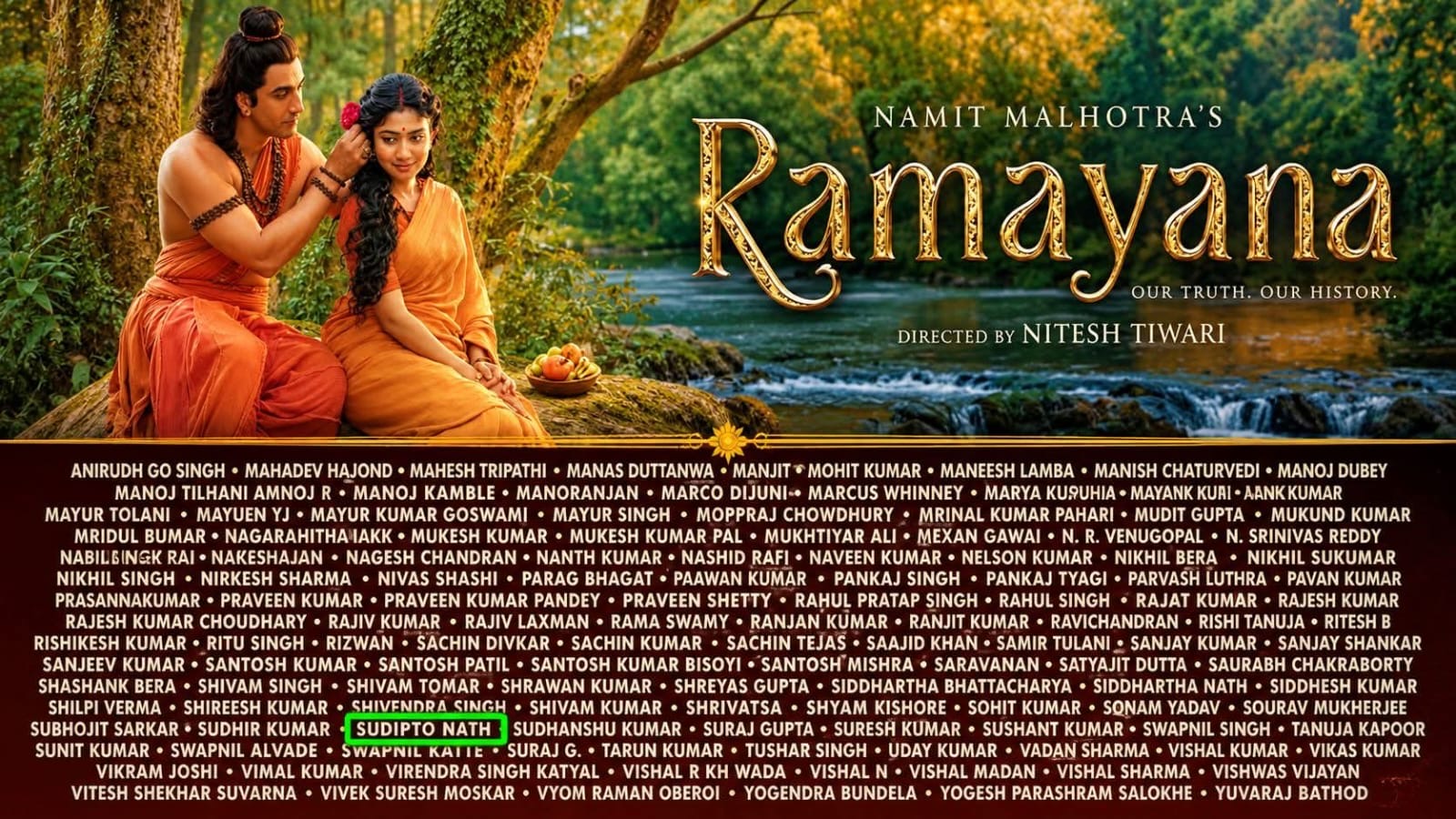
Namit Malhotra’s Ramayana, starring Ranbir Kapoor and Sai Pallavi, released on 5 November, bringing the epic to the screen with the help of cutting-edge technology. The film has already created a buzz in the global market, with its visual effects and storytelling drawing attention while introducing Indian culture and legends to a wider audience. Among the artists who contributed to the film’s visual effects team is someone with roots in Barak Valley.
Meet Sudipto Nath, an alumnus of Assam University and a resident of Jarailtola village in Borkhola, Cachar, who is currently working in Bengaluru as a Texturing Lead at DNEG, the visual effects company behind the film. As a Lead Character Texturing Artist, he worked on several important characters and assets in Ramayana, including Airavata, Tadaka, Subahu, Kumbhakarna, Mali, Parashurama, the giant warriors, Rakshasas and the Golden Deer, one of the film’s important visual elements. In total, he contributed to around 90 assets as a lead character texturing artist.
Reflecting on his journey, Sudipto said, “This is a job that was once my hobby. Being able to work on my hobby professionally is indeed very fulfilling.” His journey from a village in Cachar to working on one of India’s most ambitious cinematic projects is an inspiring example of how passion, artistic skills and years of dedication can turn a dream into a profession.
Explaining his role in the film industry, Sudipto said that texturing is an important part of the animation and visual effects process. He compared it to the work of an idol maker. An idol is initially made in grey before colours are added to represent the skin, ornaments and other details. A similar process takes place in the digital world, where 3D models are initially created in grey before artists add colours and define their surfaces, materials and natural details. This broader process is known as surfacing, which gives digital characters and objects their realistic appearance.
Before joining the Ramayana project, Sudipto had worked on several major Indian and international productions. His credits include Toxic (2026), Salaar (2023), Thor: Love and Thunder (2022), The Lord of the Rings: The Rings of Power, X-Men: Dark Phoenix (2019), X-Men: Apocalypse (2016), Pirates of the Caribbean: Dead Men Tell No Tales (2017), and Ghostbusters (2016), which was his first Hollywood film. While some projects took only a few months, such as Toxic and Salaar, Ramayana required over three years of work, making it one of his longest professional assignments.
Sudipto’s journey into the world of visual effects began with his education in the arts. After completing his Higher Secondary education in the Arts stream, he pursued a Bachelor of Fine Arts (BFA) at Assam University as part of the 2003 batch. He later completed a one-year diploma course in 3D animation in Kolkata. His professional career began in 2007 when he joined DQ Entertainment, where he worked for four years. He subsequently worked with Bengaluru-based Xentrix Studios before moving across Kolkata and Hyderabad for different assignments. He is now working with DNEG in Bengaluru.
While discussing his contribution to Ramayana, Sudipto was careful not to take individual credit for the entire work. He explained that although he served as the Lead Character Texturing Artist for around 90 assets, several other artists also contributed to the project. Some characters and assets required modifications at different stages, with other team members working on those parts. He emphasised that producing a film of this scale was a collective effort involving several talented professionals.
For young people aspiring to enter the animation and visual effects industry, Sudipto’s advice is to develop a strong foundation in art. He believes that passion, basic artistic skills and an artistic mindset are essential to succeed in this profession. While there are different ways to enter the industry, he recommends studying Fine Arts or Visual Arts to strengthen one’s understanding of art. According to him, formal education can improve the foundation, but genuine love for the craft and the willingness to keep learning are equally important.
Speaking about the financial prospects of the profession, Sudipto said that the salary can be good once a person gains experience and improves their skills. However, he admitted that the initial years can be challenging and that everyone has to go through a period of struggle. While some people manage to work through these difficulties and grow in their careers, others may leave out of frustration. He believes that those who remain dedicated and continue improving can eventually build a comfortable life and enjoy a good quality of life through this profession.
Despite his professional achievements, Sudipto remains connected to his academic roots. He said that he visited Assam University last year and often returns to the institution. Although much has changed since his student days, including the relocation of his department, the university continues to hold a special place in his journey. He also expressed satisfaction with his professional life, while making it clear that he still has the enthusiasm to take on new projects and challenges.
As Sudipto continues to work on new projects in the world of visual effects, his journey stands as a proud moment for Jarailtola, Borkhola and the wider Barak Valley. From studying Fine Arts at Assam University to helping bring characters from the Ramayana to life on the global screen, he has shown how talent from a small village can find its place in the international entertainment industry. On this Diwali, his story is a reminder that passion and perseverance can illuminate even the most distant dreams. Happy Diwali.
Comments are closed.