
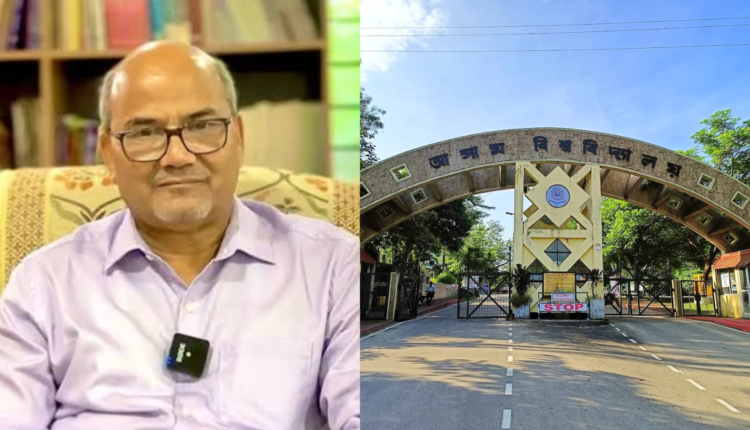
Gauhati High Court Directs Rajive Mohan Pant To Step Down As Assam University VC Over Lack Of Experience

The Gauhati High Court has set aside the appointment of Dr. Rajive Mohan Pant as Vice-Chancellor of Assam University, Silchar, holding that he did not fulfil the mandatory eligibility criteria prescribed under the University Grants Commission (UGC) Regulations, 2018. The court also found serious deficiencies in the selection process, including the failure of the Search-cum-Selection Committee to adequately verify and document the candidate’s eligibility before recommending his name.
In an order dated October 14, 2026, in W.P.(C) No. 7283/2025, Justice N. Unni Krishnan Nair allowed a writ petition filed by Dr. Samira Behera, challenging Pant’s appointment to the post.
The court quashed the appointment made through a communication dated January 14, 2022, and directed the appointing authority to entrust an eligible person of the university with the charge of Vice-Chancellor until a regular appointee assumes office. It further ordered that a fresh selection process be initiated and completed within four months from the date of receipt of a certified copy of the order.
However, the court clarified that there would be no recovery of the salary and allowances already drawn by Pant during his 4-year tenure as Vice-Chancellor.
The writ petition challenged the appointment of Pant, who assumed charge as Vice-Chancellor of Assam University on January 25, 2022, for a tenure of five years or until attaining the age of 70, whichever was earlier.
The petitioner, Dr. Samira Behera, a Professor of Mathematics at Assam University, contended that Pant did not possess the minimum qualifying experience required under Regulation 7.3(i) of the UGC Regulations on Minimum Qualifications for Appointment of Teachers and Other Academic Staff in Universities and Colleges and Measures for Maintenance of Standards in Higher Education, 2018.
The petitioner sought a writ of quo warranto, a judicial remedy through which a court examines the legal authority under which a person occupies a public office. The petition argued that Pant’s appointment was contrary to the statutory eligibility requirements and that he had no legal entitlement to continue as Vice-Chancellor.
The court first addressed objections raised by Assam University and Pant regarding the maintainability of the petition. Rejecting their objections, it held that the petitioner’s locus standi could not be questioned in a proceeding seeking a writ of quo warranto over an alleged appointment contrary to statutory rules.
The court explained that such proceedings allow judicial scrutiny of whether a person holding a public office satisfies the legal requirements for appointment. If the appointment is found to be contrary to the applicable statutory provisions, the court may direct the office-holder to vacate the post.
UGC Regulations Prescribe Two Separate Eligibility Routes
A central issue before the court was the interpretation of Regulation 7.3(i) of the UGC Regulations, 2018, which lays down the eligibility requirements for appointment as Vice-Chancellor.
The provision states that a Vice-Chancellor should be a distinguished academician possessing the highest level of competence, integrity, morals and institutional commitment, with either:
- A minimum of 10 years of experience as a Professor in a university; or
- A minimum of 10 years of experience in a reputed research and/or academic administrative organisation, supported by proof of demonstrated academic leadership.
The court noted that the Assam University Act, 1989, as amended, does not independently prescribe the eligibility criteria for appointment as Vice-Chancellor. Consequently, the requirements under the UGC Regulations governed the appointment, a position that was not disputed by the parties.
The principal dispute concerned whether experience accumulated under the two alternative eligibility routes could be combined to satisfy the minimum 10-year requirement.
The petitioner argued that the two routes were mutually exclusive because they were separated by the word “or”. According to the petitioner, a candidate had to independently satisfy either the 10-year requirement as a Professor in a university or the 10-year requirement in a qualifying research or academic administrative organisation.
The respondents, on the other hand, argued that the regulations did not require the experience to be accumulated in a single institution or in one continuous period. They maintained that experience across different institutions and roles could be considered, provided the candidate satisfied the qualitative and quantitative requirements.
The court accepted the petitioner’s interpretation, holding that the two eligibility routes had to be fulfilled independently.
Around Seven Years As Professor And Six Years As NIRD Director
According to the records discussed in the order, Pant had worked as a Professor at the North-Eastern Regional Institute of Science and Technology (NERIST), Nirjuli, Arunachal Pradesh, from August 2, 2007, to September 1, 2014.
He subsequently served as Director of the National Institute of Rural Development and Panchayati Raj (NIRD), Guwahati, for approximately six years and seven months.
His application for the Vice-Chancellor’s post disclosed his experience in these two positions. The order also records that he had a PhD and had secured 53.33 per cent marks in his Master’s degree examination.
The petitioner contended that Pant had approximately seven years of experience as a Professor, falling short of the required 10 years. His subsequent tenure as NIRD Director, the petitioner argued, could not be added to his professorial experience to make up the shortfall.
The petitioner also questioned whether NIRD qualified as a reputed research and/or academic administrative organisation under the second eligibility route. Even if it did, the petitioner argued, Pant’s approximately six years and seven months as Director would still fall short of the independently required 10 years.
The court examined these arguments against the wording of Regulation 7.3(i) and held that the experience accumulated under the two routes could not be combined.
Applying this interpretation, the court concluded that Pant did not have the minimum 10 years of experience as a Professor in a university. Nor did he have 10 years of experience as Director of NIRD. He was therefore found ineligible under either route.
Court Rejects Argument That Retaining Lien On Professor’s Post Counted As Teaching Experience
A key defence advanced by Pant and Assam University was that Pant had retained his lien on his substantive post as Professor at NERIST while serving on deputation as Director of NIRD.
They argued that because his lien on the professorial post continued during the deputation, his service as Director should be treated as a continuation of his service as a Professor. On that basis, they sought to count his tenure at NIRD towards the 10-year professorial experience requirement.
The court rejected the argument, holding that the continuation of a lien on a substantive post does not establish that the incumbent continued to perform the duties associated with that post or acquire the corresponding experience during the period of deputation.
It relied on the Supreme Court’s decision in Prof. Narendra Singh Bhandari v. Ravindra Jugran case.
In that case, the Supreme Court had held that merely retaining a lien on a Professor’s post could not convert the period spent in another position into teaching experience. It had also rejected the argument that supervising PhD scholars while serving in another role could substitute for the required teaching experience as a Professor in a university.
Applying that principle, the Gauhati High Court held that Pant’s deputation as Director of NIRD did not mean he continued teaching at NERIST during that period. It further observed that he could not simultaneously be treated as serving as a Professor at his parent university while working on deputation as Director of NIRD.
Consequently, the period spent as Director could not be added to his approximately seven years of professorial experience to satisfy the first eligibility route.
The court also considered the alternative argument that Pant’s experience as Director fell under the second eligibility route. It held that even if NIRD were assumed to qualify as a reputed research or academic administrative organisation, Pant’s tenure there was still less than the required 10 years.
Thus, the court found that he had not independently satisfied either of the two prescribed experience requirements.
Search-cum-Selection Committee Had Flagged Eligibility Doubt
Beyond Pant’s individual eligibility, the court scrutinised the procedure followed by the Search-cum-Selection Committee constituted by the Union Ministry of Education to recommend candidates for the Vice-Chancellor’s post.
The committee first met on June 3, 2021, and asked the Ministry to prepare a summary of the applications received in response to the advertisement for further deliberation.
At its meeting on June 26, 2021, the committee considered the available information on candidates and shortlisted 31 candidates for personal interaction. Pant was among those shortlisted.
However, the minutes of the June 26 meeting specifically recorded that Pant’s shortlisting was subject to confirmation of his eligibility.
The committee subsequently met on July 23–25, 2021. Following interactions with shortlisted candidates, it unanimously recommended a panel of five names for consideration by the Visitor, including Pant’s name.
The court observed that the minutes of the final meeting did not explain how the committee had resolved the eligibility concern recorded in June before recommending Pant.
The court also noted that the Ministry of Education had initially failed to produce the committee’s meeting records despite repeated adjournments. By an order dated August 28, 2026, the court directed a competent Ministry officer to appear with the original records.
On September 10, 2026, Deputy Secretary Hemant Kumar and Under Secretary Joyful Z. Khawzawl appeared before the court and produced the minutes of the meetings held on June 3, June 26 and July 23–25, 2021.
The officers informed the court that the Ministry had no further material explaining how the committee had arrived at its conclusions.
After examining the records, the court concluded that the committee had flagged the eligibility issue but had not demonstrated that it had resolved the concern before including Pant in the final panel.
The court held that his eligibility had effectively been sidestepped and that the committee had recommended his name without first recording a clear satisfaction that he met the mandatory requirements.
The court also concluded that the appointment of Pant had been made in violation of the conditions prescribed in the recruitment advertisement and Regulation 7.3 of the UGC Regulations, 2018.
The court therefore held that the appointment was legally unsustainable and that Pant had no right to continue as Vice-Chancellor of Assam University.
Comments are closed.