
Biomedical Waste Found Dumped Near TB Ward Of SMCH; Municipal Commissioner Confirms Waste Cannot Be Processed Without Incinerator

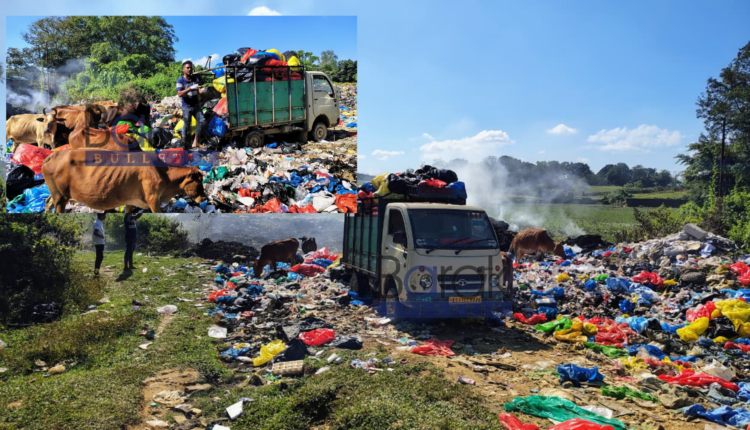
Silchar Medical College and Hospital (SMCH) is under scrutiny after Barak Bulletin correspondents, during a ground report, spotted what is alleged to be biomedical waste, dumped in colour-coded bags inside the campus, close to the Tuberculosis ward and doctors’ residential quarters. The findings, made during a ground visit on December 4, raise serious concerns about public health and compliance with national biomedical disposal norms.
The area has heaps of yellow, red, blue and black disposed bags scattered in the open, some torn apart as cattle grazed around them. When burnt, locals said, the fumes drift directly into the TB ward, posing an immediate risk to patients already suffering from compromised lung function.

A whistle-blower had earlier written to Barak Bulletin on November 21 alleging “illegal dumping and open burning” of biomedical waste near the PG hostel and TB ward of SMCH. The complainant said their patient, admitted to the TB ward, was experiencing deterioration in health due to exposure to toxic smoke. “Patients with tuberculosis are coughing, breathless, and in acute distress,” they had written, calling it a violation of biomedical waste norms.
The Biomedical Waste Management Rules, 2016 (amended 2018) mandate strict segregation and treatment of medical waste. Each colour-coded bag must be handled under specific protocols:
- Yellow Bags: Human and animal anatomical waste, soiled material, microbiology and lab waste, body fluids and expired medicines. These must be incinerated or deep buried (where permitted).
- Red Bags: Tubing, IV sets, catheters, gloves and other contaminated plastic items. These must be autoclaved or microwaved and then shredded before recycling.
- Blue Bags/Containers: Glassware such as vials, ampoules and slides, which must be disinfected and recycled after autoclaving.
- Black Bags: General non-hazardous waste meant for municipal disposal.
At SMCH, all four categories were found mixed together and dumped in the open, contrary to the rules.
2024 Data from the Pollution Control Board of Assam shows Cachar district generates 588.95 kg of biomedical waste daily, of which 332.35 kg comes from government hospitals, including SMCH. Non-government hospitals contribute another 256.60 kg. Without proper treatment facilities, experts warn that even a temporary lapse can expose large populations to infectious and chemical hazards.
This is not the first time SMCH’s waste management has come under question. A Telegraph report from November 2024 stated that every hospital is legally required to have an incinerator of nearly 30 metres in height. The report claimed SMCH had been disposing of biomedical waste in the open for years and that a financial irregularity surfaced when it was revealed that Rs. 22 lakh had been paid to a Guwahati-based firm to supply an incinerator, which was never delivered.
Following Barak Bulletin’s inability to obtain a clear response from SMCH authorities, the matter was reported to the Silchar Municipal Corporation. Commissioner Srishti Singh visited the site with a team on December 5 and acknowledged the severity of the problem.
“It is biomedical waste. It cannot be processed without an incinerator,” she told Barak Bulletin. As per the commissioner’s preliminary visit, she found that the Principal has already put up the proposal, but it will take some time for capacity building.
Until an incinerator or alternative compliant system is operational, biomedical waste continues to accumulate in the open within the hospital premises.
Public health experts say that dumping biomedical waste beside a TB ward is not just procedural negligence but a direct threat to life, especially for patients whose respiratory systems are already weakened. A failure in waste management at this high-footfall facility of this scale can have widespread consequences.
Comments are closed.