
Naari Shakti, Parivaarvaad, and BJP: What’s the Reality in Cachar?

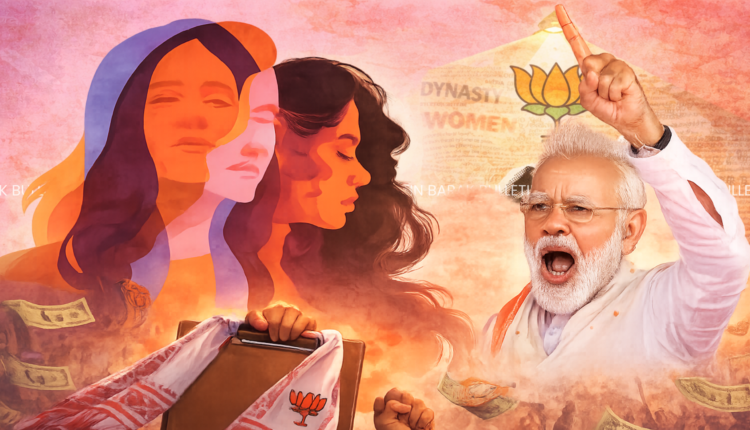
On Saturday evening, Prime Minister Narendra Modi addressed the nation like a man who had been wronged. He apologised to the women of India. He invoked Nari Shakti. He pointed fingers at Congress, AITMC, DMK, and the Samajwadi Party – accusing them of “selfish politics” that had “crushed the dreams” of India’s women. He called them Parivaarvaadi parties: dynasties masquerading as democracies, recycling surnames where they should be nurturing talent.
The occasion was the defeat of the Constitution (One Hundred and Thirty-First Amendment) Bill, 2026 in the Lok Sabha. The Bill, which sought to increase House strength to 850 seats as a mechanism to operationalise women’s reservation, fell short of the two-thirds majority required. Of 528 members present and voting, the government needed 352. It got 298.
The speech was well-crafted, emotionally resonant, politically sharp. But a publication’s obligation is to ask not what the speech said – but what the facts say. And the facts, right here in Cachar, say something very different.
The Irony
The BJP was constituted on 6 April 1980, with Atal Bihari Vajpayee as its founding President. That same year, the party was planted in Cachar by Kabindra Purkayastha – a pracharak, an RSS man, an ideological soldier present at the party’s very first adhiveshan where Vajpayee himself sought him out. He won the Silchar Lok Sabha seat in 1991, again in 1998 – serving as Minister of State for Telecommunications under Vajpayee – and a third time in 2009, defeating both Santosh Mohan Dev of Congress and Badruddin Ajmal of AIUDF in the same contest. He died in January 2026 at the Silchar Medical College and Hospital, having given his entire life to the party. By any reckoning, he was the patriarch of Assam BJP.
His political legacy, continues through his son. Kanad Purkayastha today sits in the Rajya Sabha, rooted in the very constituency his father built from scratch. He is widely regarded as hardworking and effective, and this publication has no quarrel with his conduct in office. But measured against the Prime Minister’s own Saturday-night standard, this is Parivaarvaad – a political surname translating into political capital, within the very party that coined the term as an insult.
Forty-Six Years, Three Women, Four Tickets
Before arriving at 2026, it is worth examining the BJP’s actual record on Nari Shakti in Cachar across four decades. The answer is stark: the party has fielded exactly four women candidates in Cachar since its founding – Rumi Nath from Borkhola in 2006, Reena Singh from Lakhipur in 2006 and 2011, and Bijoy Lakshmi Chakraborty from Borkhola in 2011. Not one since 2011. Not one since Narendra Modi became Prime Minister.
And for those keeping score on the Parivaarvaad front: Rumi Nath is the daughter of Trailakkha Nath, a veteran BJP figure from the same district. The glass ceiling was cracked, but along a familiar bloodline. She subsequently defected to Congress, won on a Congress ticket, and the BJP – apparently relieved – has not fielded another woman in Cachar since.
Compare this to Congress. Whatever its national failings, it has produced and fielded women leaders in Cachar across generations. Jyotsna Chanda was elected MLA from Silchar in 1957 and served three terms as Member of Parliament from Silchar in 1962, 1967, and 1971 – a legislator and parliamentarian when women in politics were an exception, not a talking point. Sushmita Dev – yes, the daughter of Santosh Mohan Dev, which in the Prime Minister’s vocabulary would qualify as Parivaarvaad – was elected MLA from Silchar in 2011, became Lok Sabha MP in 2014, served as President of the All India Mahila Congress, and was recognised as Best Woman Parliamentarian of 2016. She consistently raised issues of women’s safety, child rights, and the chronic underdevelopment of Barak Valley in Parliament. Before her, Bithika Dev, Santosh Mohan Dev’s wife, also represented Silchar in the state legislature.
If Parivaarvaad is to be the charge, then the Congress’s Parivaarvaad produced Jyotsna Chanda, Bithika Dev, and Sushmita Dev. The BJP’s Parivaarvaad – Rajdeep Roy, Kanad Purkayastha, Rajdeep Goala – has produced, without exception, men.
The 2026 Candidate List: Dynasty, Delivered
Now examine the BJP’s 2026 Cachar assembly candidates in their full particulars.
From Silchar: Dr Rajdeep Roy. A qualified orthopaedic surgeon, his 2019 Lok Sabha victory over Sushmita Dev by over 80,000 votes was a genuine mandate. What is also beyond dispute is the line on his affidavit: Son of: Late Bimolangshu Roy – a prominent BJP MLA from Silchar. Roy first contested Silchar in 2011, lost to Sushmita Dev, ascended to Parliament in 2019, and now returns to contest as an MLA – a round trip from assembly to Parliament and back that is unusual in Indian politics and speaks to a constituency treated as family property across electoral formats.
From Udharbond: Rajdeep Goala. Professor Dinesh Prasad Goala held the Lakhipur seat for seven consecutive terms between 1983 and his death in 2014 – one of the most sustained single-family dominances of any constituency in Assam’s history. He served as Minister of Power and Public Health Engineering from 1991 to 2006. When he died, his son Rajdeep Goala won the by-election, retained the seat through 2016, then joined the BJP before 2021. Now he contests from Udharbond on a BJP ticket: the son of a Congress dynasty, recycled and legitimised by the party that campaigns most loudly against the very recycling it is practising.
And in the Rajya Sabha sits Kanad Purkayastha – son of the man who built Assam BJP from nothing.
Three prominent BJP presences connected to Cachar. Three inherited surnames. The Parivaarvaad jibe, deployed from Raisina Hill on a Saturday evening, is self-evidently a one-way mirror.
Zero Women: Not a Footnote, a Statement
Count the women in the BJP’s complete 2026 Cachar candidate list: Rajdeep Roy in Silchar, Amiya Kanti Das in Dholai, Rajdeep Goala in Udharbond, Kaushik Rai in Lakhipur, Kishore Nath in Borkhola, Kamalakhya Dey Purkayastha in Katigorah, and Karim Uddin Barbhuiya – alliance candidate from AGP in Sonai. The number of women on that list is zero. As per the Chief Electoral Officer’s final roll for the 2026 Assam Assembly election, the seven Cachar assembly segments together had 13,88,541 electors – of whom 6,93,635 were women. In the same electoral cycle in which their Prime Minister went on national television to apologise to the women of India, the BJP in Cachar decided that not a single woman in this district – among its women teachers, doctors, farmers, and tea-garden workers – was worthy of a single assembly ticket.
Nationally, the picture is not much more flattering. In the 2024 Lok Sabha elections, BJP elected 31 women MPs – approximately 12 per cent of its 240 seats. This is comparable to Congress at 14 per cent of its 99 seats. Meanwhile, Trinamool Congress – the party led by a woman Chief Minister, a party that the Prime Minister’s allies regularly deride – elected women in 38 per cent of its seats. The party mocked as anti-women outperformed the party claiming the Nari Shakti franchise by more than three times on the only metric that actually counts: seats given to women, and won.
The Nari Shakti Vandan Adhiniyam of 2023, it is worth recalling, was passed unanimously by Parliament. The constitutional amendment that fell on Friday was a complex package that also sought to expand Lok Sabha to 850 seats and restructure parliamentary arithmetic and Union-state relations in ways that drew legitimate concern from opposition parties. One may agree or disagree with their reading of it. But “opposing a Bill that bundles women’s reservation with a fundamental restructuring of parliamentary power” is not the same as being “anti-women.” It is, at minimum, a serious political argument that deserves engagement rather than the language of moral condemnation.
The Uttario Problem
There is a ritual familiar to anyone who has attended a BJP event in Barak Valley. A woman – sometimes a member of the Mahila Morcha, sometimes simply a face chosen for the occasion – stands on a decorated stage and presents an uttario or the traditional Assamese gamosa, to a visiting dignitary. She smiles. She is photographed. She is thanked. She returns to her seat.
Is this Nari Shakti?
The question is not sarcastic. It is entirely sincere. Because if women’s empowerment means ceremony, symbol, and decoration – if it means holding a tray on a stage and receiving applause for doing so – then the BJP’s record in Cachar is adequate. There are photographs in abundance. But if women’s empowerment means power – real power, the power to contest, to win, to represent, to legislate, to hold office and be accountable – then what the party offers in this district is a wasteland dressed up as a garden (Kochuripana sobuj hole o sobujayan noy)
Governance in Cachar over the past decade has been almost entirely male. The parliamentary seat, the assembly seats, the party district office – male. The delegation that travels to Dispur to argue for the valley’s interests – male.
A One-Way Street
Prime Minister Modi’s address on Saturday was politically effective. It painted a vivid picture: BJP as champion of women, opposition as a club of dynasties and hypocrites. The canvas was national and the brush was broad.
But a publication’s obligation is to apply the brush locally – to ask not what the speech said, but what the facts say. And the facts in Cachar say this: the party accusing others of Parivaarvaad has fielded the son of a former MLA in Silchar, has absorbed and now fields the son of a seven-term MLA in Udharbond, and has the son of its own founding patriarch in the Rajya Sabha. One of the three women the party ever fielded for a Cachar, in its 46-year history was herself the daughter of a party veteran. The party decrying the suppression of Nari Shakti has given zero women a ticket across seven constituencies in the district most identified with its strongest regional foothold.
None of this is to give Congress, TMC, DMK, or the Samajwadi Party a clean pass. Their records on women’s representation and dynastic politics are equally unimpressive and deserve their own scrutiny. What is not debatable is that no party in Indian politics has a spotless record on genuinely empowering women in electoral competition – and in Cachar in 2026, no party has done worse on that count than the BJP. Yet, Congress that Prime Minister accused of being anti-women, is at 10 tickets to women in Cachar (Lok Sabha and Assembly put together) against four of BJP.
If the Prime Minister’s apology to the women of India on Saturday evening was genuine, then those within the BJP who drew up the Cachar candidate list owe their own apology – to the women of this district, to the idea of Nari Shakti, and to the ordinary democratic demand for consistency between what a party preaches from a national podium and what it practises in its own backyard.
Holding a tray with an uttario is not empowerment. A ticket is empowerment. A seat is empowerment. Power – real, electoral, legislative power – is empowerment. Until the BJP in Cachar demonstrates any seriousness about offering that, it would be wiser to lower the rhetorical temperature on Saturday nights, and do the harder, quieter, less photogenic work of walking the talk.
Comments are closed.