
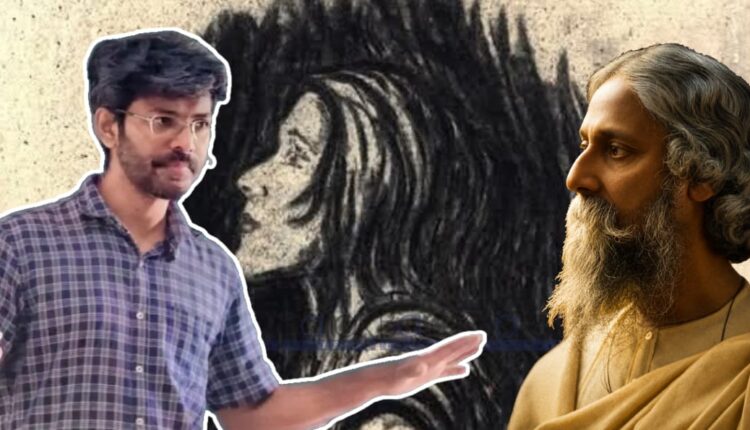
“More Artist Than Scientist”: Breakthrough Prize Physicist Atanu Nath Finds Harmony in Physics and Rabindra Sangeet

Back in 2021, when the first results of the Muon g-2 experiment were published, Barak Bulletin had highlighted the name of a young physicist from Assam, Atanu Nath. At the time, it was an early milestone in a long scientific journey. Today, that same experiment has gone on to receive the prestigious Breakthrough Prize in Fundamental Physics, often called the “Oscars of Science”, marking a major global recognition and adding a significant chapter to Nath’s journey.
Hailing from Hailakandi district and born in the town of Lala Bazar, Atanu Nath played a key role as part of the international team behind the Muon g-2 experiment. He also served as one of the run coordinators of the experiment during its final stage. His contribution helped the collaboration achieve one of the most precise measurements in the history of physics. With this, he has become the only scientist from Northeast India to be part of a team receiving this honour, placing the region on the global scientific map.
“Follow your dreams, but do not follow borrowed dreams. Let it be your dream, not your teacher’s, not your parents’, but your own”
— Dr Atanu Nath.
Speaking to Barak Bulletin during his journey back to Tihu, Nath reflected on the recognition with humility. He said he felt more excitement during the process of research than after receiving the award. Watching even small results appear on the screen during experiments gave him immense joy. While he believes the experiment deserves such honours, he does not see himself as an individual “breakthrough physicist”, emphasising that the achievement belongs to the entire team. However, he admitted feeling proud when visiting his alma mater, GC College, where he realised his journey could inspire students to pursue fundamental science.
Explaining the experiment, Nath said the Muon g-2 project was designed to test the Standard Model of physics, which is currently the most complete framework explaining the universe. This model includes fundamental particles such as electrons, quarks and neutrinos, along with force-carrying particles like photons, and even predicts particles like the Higgs boson, often referred to as the “God particle”, which gives mass to matter.
However, he pointed out that the Standard Model does not explain everything. Phenomena like dark matter and dark energy remain unresolved. Galaxies appear to be held together by more mass than we can detect, suggesting the presence of unknown particles. Similarly, the universe is expanding at an accelerating rate, something current theories cannot fully explain.
The Muon g-2 experiment, he clarified, was not about definitively proving the theory wrong but about testing it with extreme precision. The team measured how muons behave in a magnetic field and compared the results with theoretical predictions. While the experiment does not conclusively prove that the Standard Model is incomplete, it has revealed the largest and most precise discrepancy so far. Nath described it as the strictest test of the model to date, adding that their results are among the most accurate measurements ever achieved in science. Future theoretical calculations and further experiments will determine whether this gap truly points to new physics.
Reflecting on his academic roots, Nath credited GC College for shaping his journey. He recalled interacting with string theorist Ashoke Sen of HRI, who was among the first recipients of the Breakthrough Prize in Fundamental Physics, during a conference at the college, which left a lasting impact on him. He also spoke highly of his teacher, Surajit Sen, describing him as deeply devoted to physics. Nath said Surajit Sen guided him with books, challenging problems, and constant encouragement, playing a crucial role in his development. He added that despite his contributions, Surajit Sen remains undervalued in the Barak Valley, even though he is recognised within academic circles outside the region.
Addressing students who struggle financially to pursue higher studies, Nath shared that he had faced similar challenges. He stressed that opportunities do exist through scholarships and entrance exams like JEST. He explained that institutions often provide financial support, free accommodation and subsidised food, making it possible for students to continue their education without burden. He encouraged students to explore these options rather than giving up midway.
On the growing media attention, including the creation of a dedicated page on Wikipedia, Atanu Nath responded with notable humility. He acknowledged the recognition with gratitude but maintained that he does not yet feel he fully deserves it. According to him, such honours should come after a longer and more substantial body of individual work.
Nath emphasised that his current achievement is part of a collective effort rather than a personal milestone. While he appreciates the visibility and understands its significance, he believes he still has a long way to go in his academic journey. For him, the focus remains on continuing his work and contributing further to the field, rather than dwelling on recognition at this stage.
Away from physics, Nath revealed a deeply artistic side. He described himself as “more of an artist than a scientist at the core”. While he once enjoyed painting, he could not continue due to academic pressures. Singing, especially Rabindra Sangeet, became his way of staying connected to art. He mentioned that the song “Amaro Porano Jaha Chay” resonates with him deeply.
Responding to racist comments he faced online after his achievement gained attention, Nath said such behaviour is unacceptable but does not reflect reality. He shared that during his five years in Brahmaputra Valley, he never experienced discrimination. His students, mostly Assamese and Bodo, have always supported and appreciated him. He recalled being invited to sing Rabindra Sangeet during International Mother Tongue Day celebrations, which was warmly received. He pointed out that social media often amplifies negativity and that racism exists on both sides, which is equally wrong. He encouraged people to travel, understand different communities and experience different cultures. He also praised the indigenous tribal culture of Northeast which he described as progressive.
Ending on a reflective note, Nath had a clear message for young people. He urged students to respect their own dreams and not be influenced by others. “They should not follow borrowed dreams. It should be their dreams, not their teacher’s, not their parents’, but their own,” he said.
Comments are closed.