
Rath Yatra: The Day Goddess Durga Is Invited Home

Byline: Gungun Ghosh Adhikari
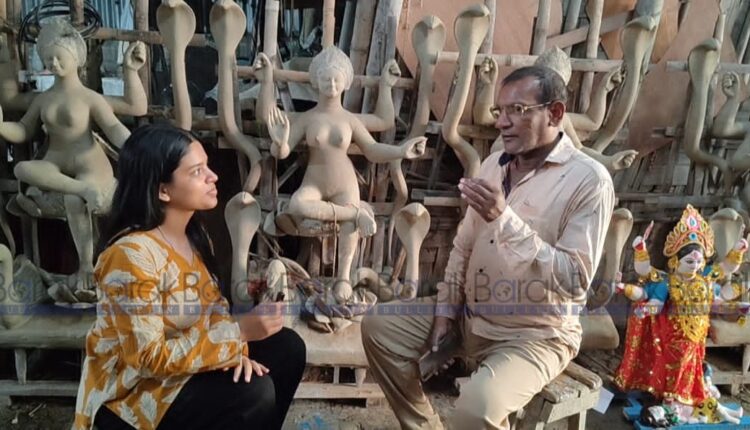
With nearly 90 days left for Durga Puja, the festival that every Bengali waits for through the whole year, Barak Bulletin visited Gaur Pushpa Shilpaloy in Silchar and sat down with Gopal Paul, an experienced idol maker of the Barak Valley, to understand what truly goes into creating the breathtaking idols that mesmerise thousands every year.
Gopal Paul currently serves as the Sampadak of Cachar Mrit Shilpi Samiti. He did not choose this craft — it chose him through his forefathers, who were associated with idol making long before him. His family has been practising this craft for nearly 100 years. Today, his sons, other family members and fellow artisans assist him, keeping the tradition alive within the family across generations.
“On Rath Yatra, we invite Maa Durga through sacred rituals. Only after seeking her blessings do we begin making the idol.” — Gopal Paul, Sampadak, Cachar Mrit Shilpi Samiti.
When asked how it feels to create idols of the goddess whom the whole of society worships, Paul paused before answering. The joy of the craft, he said, is real and deep. Every idol he makes is worshipped by devotees. But he was equally firm about the sorrow that comes with it. He spoke at length about how idols are often abandoned by roadsides after immersion, left to melt in rainwater without any proper ritual. He also pointed to the practice of blasting loud music during immersion processions while simultaneously disposing of the idols on roadsides. He urged the public to ensure this does not happen and that the goddess is given the respect she deserves even in her final moments.
On the question of whether factory-made idols have reduced demand for handmade ones, Paul was clear. Industry-made idols, he explained, are at most two and a half to three feet in size and are made from burnt clay. Burnt clay idols are not worshipped. As a result, people across the Barak Valley continue to purchase only handmade idols for worship. The tradition of handmade idol worship remains intact in this region.
The process of making an idol, Paul explained, begins long before the clay is touched. The foundation is built first using bamboo, wood, sticks, nails and threads. A two and a half to three feet idol requires approximately two days just for the clay work alone. A twelve foot idol of Goddess Durga, of the kind seen in major pandals, takes twenty days of clay work and requires a team of six to seven people working together just to complete that one idol. Paul also raised the issue of rising costs, noting that the price of raw materials has doubled compared to 2025 rates. He requested customers to understand this reality and not ask artisans to lower their prices, as the increase in material costs necessarily means the price of idols must also rise if the craft is to survive.
For any young person wishing to learn this craft, Paul had a measured and honest answer. There is no shortcut and no course. One must first learn to process bamboo, how to cut it properly, how to prepare seven to eight different types of clay and how to mend broken idols. This alone takes three to four years to learn. To fully master the craft takes at least fifteen years. For a particularly gifted student, it may take ten. Those ten or fifteen years are the course itself. For specialised work in fibre, cement and marble, formal education is additionally required.
Paul also shared the sacred rituals that precede the making of the idol. Before the structure is even begun, the goddess is formally invited by the women of the family on auspicious days such as Rath Yatra and Janmashtami. Only after this invitation is the structure finally constructed. Once the idol is complete, the ritual of Chokhu Daan takes place. During this ritual the mandap is covered and only the person performing the daan is permitted to remain inside. The eyes of the goddess are drawn using kajal extracted from a ghee lamp, applied with a leaf of wood apple. In earlier times, the quill of a porcupine was used to draw the eyes.
When asked what needs to be done to keep this craft alive, Paul was candid. The new generation, he said, is not drawn to such demanding work. An idol maker must sacrifice outings, regular meal times and personal comfort. The craft demands complete dedication and an extraordinary sense of responsibility. Paul and his fellow artisans are actively trying to encourage young people to take it up. But ultimately, he said, it is the general public that must step forward and support the artists. Without that support, this living craft of the Barak Valley may not survive the next generation.
Comments are closed.