
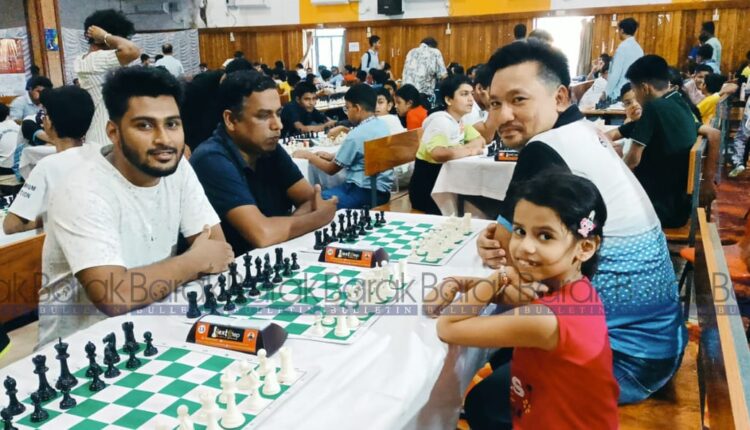

Chess, originated in ancient India as Chaturanga, has travelled across continents and evolved over centuries into one of the world’s most popular mind sports. Today, it is played by millions and remains a source of national pride for India, which has produced world champions, grandmasters and remarkable young talents. While Barak Valley may not yet have a grandmaster, it is proving that it is not behind when it comes to nurturing the next generation of chess players.
Among the district’s rising talents are seven-year-old Troyee Roy, nine-year-old Monodeep Dhar, ten-year-old Bhargab Debnath, seventeen-year-old Abhrojyoti Nath and many more. Troyee recently competed in the Under-7 Girls category at the Assam State Chess Championship and qualified for the national championship. She is also the youngest FIDE-rated female chess player in Silchar and has been trained from the beginning by National Instructor Deep Das. Monodeep is the reigning Assam Under-9 champion, while Bhargab has consistently impressed in competitive tournaments across the state. Abhrojyoti has represented India at the World Youth Championship and won the Assam University Blitz Open ahead of several titled players. Together, they represent the promising young generation carrying Cachar’s chess aspirations forward.
In Cachar’s recent chess history, the establishment of the Cachar District Chess Association in 1993 marked a major turning point. The association was formed with the aim of developing the chess atmosphere within the district and introducing more children to the game. In its early years, much of the focus was on providing free coaching and basic training opportunities. As the local chess community grew stronger, the association gradually shifted its focus towards broader efforts aimed at developing the region’s overall chess ecosystem.
Speaking to Barak Bulletin, Cachar District Chess Association president Bibendu Das said the chess atmosphere in the district has improved considerably over the years. More children are taking up the game and more families are willing to support them. Das especially praised parents for the role they play in nurturing young players. He said that whenever tournaments or training programmes are organised, parents are among the biggest supporters. According to him, without their encouragement and sacrifices, many young players would not have been able to continue their chess journey.
When asked whether Silchar could one day produce a player like Gukesh Dommaraju, Das replied with confidence that it certainly could. He explained that regions such as Tamil Nadu consistently produce top chess talents because of a well-developed chess culture, strong competition, experienced coaches and sponsorship opportunities. According to him, players such as Viswanathan Anand, R Praggnanandhaa and Gukesh emerged from an environment that actively supports chess. He believes Cachar still has a long way to go, but is confident that one day the district, along with the rest of the Northeast, will produce players of similar stature.
Das also pointed to Mayank Chakraborty as an example of what is possible. He noted that Mayank became the first Grandmaster from Northeast India at the age of 16, a landmark achievement for the region. According to Das, Mayank’s success shows that players from the Northeast can compete at the highest levels despite facing challenges that are not present in more established chess centres. He described the young grandmaster’s achievement as a beacon of hope for the future of chess across the region.
The achievements of Troyee Roy, Abhrojyoti Nath, Monodeep Dhar and Bhargab Debnath demonstrate the potential that exists within Cachar district. Their success reflects not only individual talent but also the support of coaches, parents and the wider chess community. As more young players take up the game and opportunities continue to grow, many more talents are likely to emerge. For now, the focus remains on building the foundation. If the right elements continue to be nurtured and developed, the district may one day produce players capable of competing on the biggest stages in world chess.
Research and reporting assistance by K. Alicia Rongmei
Comments are closed.