
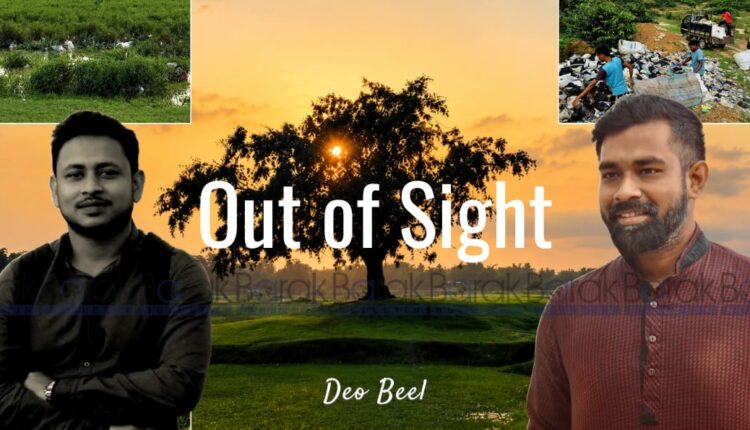
Out of Sight: The Journey of Plastic From Irongmara to Chatla and Back Into Our Lives

Byline: Amzad Hussain Choudhary
Every day, plastic bottles, food wrappers and discarded bags disappear into drains across Silchar. Once they leave our sight, most of us rarely think about them again. But where do they actually go? That simple question led two Assam University researchers to create Out of Sight: Plastic Pollution in Irongmara & Chatla, a short documentary that traces the hidden journey of waste from urban drains to wetlands that support local communities.
The documentary was conceptualised and scripted by Sibam Sarkar, a Research Scholar in the Department of Ecology and Environmental Science at Assam University, and directed and edited by Surajit Chanda, a microbiologist and researcher associated with Cachar Cancer Hospital and Research Centre. Through a combination of field observations, interviews and visual storytelling, the film explores how plastic pollution is quietly reshaping local ecosystems.
According to Sibam Sarkar, the idea first emerged during the floods of 2022. While floodwaters covered large parts of the region, he noticed plastic waste scattered almost everywhere. Even after the waters receded, the waste remained. The experience left him wondering where all this garbage eventually ends up.
As someone working in biodiversity conservation and natural resource management, Sibam Sarkar felt that the issue deserved greater public attention. What began as a simple observation gradually developed into an effort to understand how waste travels through the environment and affects both nature and people.
To tell that story visually, he partnered with Surajit Chanda. What they found during field visits was more troubling than they had expected.
While filming in Irongmara and Chatla, Surajit Chanda observed that pollution was not merely an environmental problem visible in drains and dumping sites. It was affecting landscapes and livelihoods. One of the people featured in the documentary was a farmer who recalled cultivating rice in an area where farming is no longer possible in the same way today. According to the farmer, plastic waste had clogged drainage channels, caused flooding, and accumulated in agricultural fields, making cultivation increasingly difficult over the years. As a result, environmental changes forced many residents to adapt to different ways of earning a living.
The filmmakers also noticed a difference in how generations viewed the problem. Older residents remembered a time when reusable materials were common and plastic waste was far less visible. Younger generations had grown up surrounded by plastic and often viewed it as a normal part of everyday life.
The documentary goes beyond visible pollution and focuses on a growing concern that many people are unaware of: microplastics. These tiny plastic particles are created when larger plastic items break down over time. According to Sibam Sarkar, scientific studies have found microplastics in food, water, bloodstreams and even breast milk. Yet public awareness about the issue remains limited.
The journey documented in the film eventually leads to wetlands connected to Irongmara and Chatla. Canals carrying waste from populated areas flow into these ecosystems, bringing not only plastic but other pollutants as well. At the same time, these wetlands continue to provide fish, vegetables and other resources that reach local markets. As the documentary points out, pollution in these wetlands does not stay there; it can eventually return to people through the fish, vegetables, and other resources they consume.
For the filmmakers, this connection carries an important message. Waste does not simply disappear after it is thrown away. It moves through ecosystems and can eventually return to human lives through food and water.
Creating the documentary was not without challenges. The team wanted more community members to share their experiences on camera, but many were hesitant to speak publicly. Technical limitations also affected filming, particularly when documenting wildlife and wetland ecosystems. During editing, several interviews and footage had to be left out due to time constraints and consent-related concerns.
What makes the project particularly notable is that it was entirely self-funded. There was no sponsorship behind the film. Both Sibam Sarkar and Surajit Chanda pursued the project out of personal interest and concern for the environment. Although their backgrounds are in science, both have long-standing interests in photography, nature observation and storytelling.
Ultimately, Out of Sight is not just about plastic pollution. It is about responsibility. Both Sibam Sarkar and Surajit Chanda emphasised that environmental protection cannot be left solely to authorities. They believe that meaningful change will only be possible when communities and individuals actively participate in reducing waste and protecting local ecosystems.
The documentary’s title captures a habit shared by many people. Once garbage leaves our hands, it disappears from our attention. But as Out of Sight demonstrates, nature never forgets where that waste goes.
By following plastic’s journey from drains to wetlands, the film reminds viewers that the things we throw away today may return to us tomorrow in ways we cannot always see.
Comments are closed.